The examined life · Confucian thought
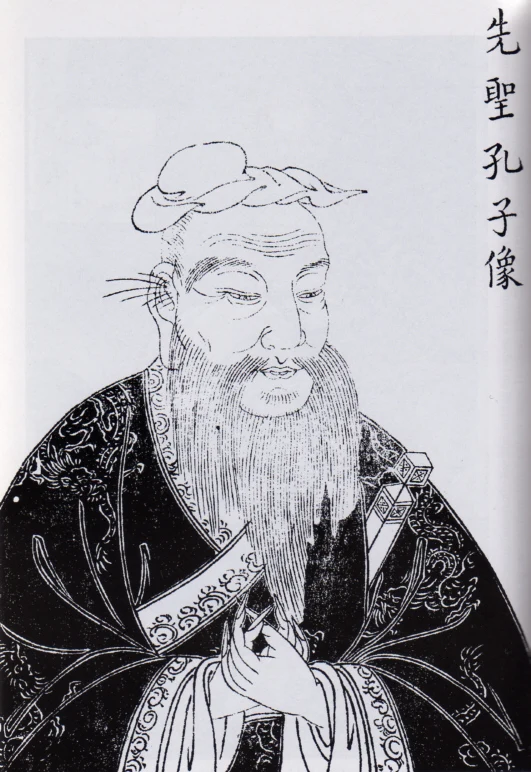
Confucius.Character lives
between people.
For Confucius, self-cultivation involves learning to act well in your relationships. Study, ritual, and reflection give care a visible form: what you say, how you listen, and whether your conduct deserves trust.


You promised to send something by Friday. Friday passes. On Monday, you open a message from the person still waiting. Your intentions may have been good. From their side, the experience is a missing promise. This small gap between intention and conduct is where our reading of Confucius begins.
The idea in everyday life
A promise, seen from both sides.

Someone waits
Your good intention is invisible to the person who is still waiting for the work.
You speak plainly
Acknowledge the missed promise and agree on a deadline you can actually meet.
You follow through
Send the work when you said you would. Let the action carry the apology.
An illustrative modern scenario. Trust is practiced through a clear commitment and the action that follows. Illustrations generated with AI.
Take this with youMake one value observable in one relationship today.
01The person
A life of learning, in a changing world
Confucius is the Latinized name of Kongzi, or Master Kong. His traditional dates are 551–479 BCE. He lived during a period when the Zhou political order was weakening and regional states were gaining independence. His teaching connected personal conduct with the condition of family and public life.
The Analects is a collection of conversations and sayings associated with Confucius and his followers, transmitted and compiled over time. It is not a book he sat down to write as a modern author. Details of his biography also come through later accounts, so the historical person and the traditions around him cannot always be neatly separated. Life, sources, and transmission ↗
That context changes the reading. Self-cultivation here reaches beyond personal productivity. It asks what kind of person a friend, child, colleague, or community encounters when they encounter you.
Watch, then return to the question
Who was Confucius?
Bryan W. Van Norden · TED-Ed. Watch on YouTube · Lesson & further reading
Watch for the connection between learning and conduct. In the story below, a value becomes visible only when a promise is kept.
02The vocabulary
Care needs a form
Three ideas offer a useful starting point. Ren is often translated as humaneness or benevolence. Li concerns ritual and appropriate conduct. Junzi, often translated as exemplary person, names a moral ideal. Translation choices differ; none of these terms is exhausted by one English word.
In Analects 3.3, Confucius questions what ritual amounts to without humaneness. In 2.13, conduct comes before claims about oneself. Together, these passages invite a practical question: how does the care you intend become the conduct another person experiences? Analects 2.13 and 3.3 ↗

- 01
Ren · the concern
“This person’s time and effort matter.”
- 02
Li · the expression
Listen fully. Give notice. Keep the agreement clear.
- 03
Cultivation · the practice
Notice a failure, repair it, and practice again.
This diagram is a modern reading aid, not a complete map of Confucian ethics. Ancient ritual included ceremonies, mourning, and social distinctions. A phone-free conversation is our present-day example of giving attention a deliberate form.
03A real situation
Repair the promise before defending the intention
Return to the missed Friday deadline. An elaborate explanation might protect your self-image while leaving the other person to chase you. A useful repair starts with what they need now: acknowledgment, a realistic commitment, and a chance to respond.
“Sorry, things have been crazy. I’ll get to it soon.”
“I missed Friday’s deadline and should have warned you. I can send a complete draft by Tuesday at noon. Does that still work for what you need?”
The second message is not a magic script. It gives the other person something they can plan around. If Tuesday is unrealistic, do not offer it. Repair may require renegotiating the task or admitting that you cannot do it.
Analects 2.22 stresses the importance of trustworthiness. Our example applies that concern to an ordinary commitment: let the next promise be small enough, and clear enough, to keep. Analects 2.22 ↗
04The necessary nuance
Respect leaves room for disagreement
Confucius gives family relationships and social roles a central place. The Analects reflects an ancient hierarchical society; it should not be presented as if it already shared every modern commitment to equality. Applying it today requires judgment.
Nor should respect become a demand to agree with whatever a powerful person says. In Analects 13.15, the danger of a ruler whose words nobody contradicts is made explicit. Analects 13.15 ↗
In a team, respectful conduct can mean saying, “I think that deadline puts the work at risk,” and explaining why. In a family, it can mean setting a limit without an insult. Someone else may dislike the limit. That does not automatically make it disrespectful.
These are modern applications, not claims that the ancient text offers a complete guide to every relationship. The question worth carrying forward is whether your conduct combines care with honesty.
05Try it today
A five-minute review of one relationship
In Analects 1.4, the speaker Zengzi examines his conduct toward others, his sincerity with friends, and his practice of what he has learned. The attribution matters: this is a voice within the tradition, not a quotation spoken by Confucius. Analects 1.4 ↗
Use the following exercise as our adaptation. Pick one relationship and one recent moment. You do not need to audit your whole character.
Name the value you wanted to express.
For example: respect for your colleague’s time, patience with a friend, or honesty with your partner.
Describe what the other person could observe.
Did you arrive, listen, reply, interrupt, or disappear? Use an action rather than a verdict about yourself.
Choose one repair or repeatable practice.
Send the missing update. Ask a question before offering advice. Give notice before changing a plan.
Return to it tomorrow.
Did you do the action? What did you learn from the response? Adjust the commitment if it was unrealistic.
Keep the review proportionate. One missed promise does not define a whole person. The purpose is to make the next interaction more trustworthy. Let your next act carry the value that your intentions already claim.
A few useful distinctions
Questions, answered.
What did Confucius teach about self-development?
His teaching connects learning and self-correction with conduct toward others. The aim is moral cultivation: becoming someone who expresses humaneness and acts appropriately in relationships, rather than merely accumulating knowledge or personal achievements.
What is the difference between ren and li?
Ren is commonly translated as humaneness or benevolence. Li refers to ritual and appropriate conduct. They are connected: Analects 3.3 challenges the value of ritual when humaneness is absent. The translations are useful starting points, not exact equivalents.
What does junzi mean?
Junzi is often rendered as exemplary person or gentleman. The term carries an older association with social standing, while the Analects uses it as an ethical ideal. In this guide, “exemplary person” emphasizes the conduct a learner aims to cultivate.
Did Confucius write the Analects?
The Analects developed through the transmission and collection of sayings and conversations associated with Confucius and his followers. It includes other speakers, such as Zengzi in 1.4, and should not be treated as a single book authored directly by Confucius.
Sources & reading notes
Passage numbers identify the ancient text. The examples, visual metaphor, and five-minute review are our modern adaptations. They do not erase the historical distance between ancient ritual roles and present-day relationships.
- The Analects 1.4, 2.13, 2.22, and 3.3 ↗
Primary text, James Legge translation, Internet Classics Archive. Reflection, conduct, trustworthiness, and ritual.
- The Analects 13.15 ↗
Primary text, James Legge translation. The danger of a ruler whose words meet no contradiction.
- Stanford Encyclopedia of Philosophy: Confucius ↗
Scholarly reference for the historical context, textual transmission, and meanings of key terms.
Build a practice you can return to
One thought.
One useful action.
Start with the exercise above. For updates about Be The One, join the early-access list.
Join early access