Communication
The Power Of Silence
Quiet strength is the signal almost no one else is sending. In a culture that rewards noise, the person who speaks less and listens more commands a room that the loudest voice can never reach.

In this article
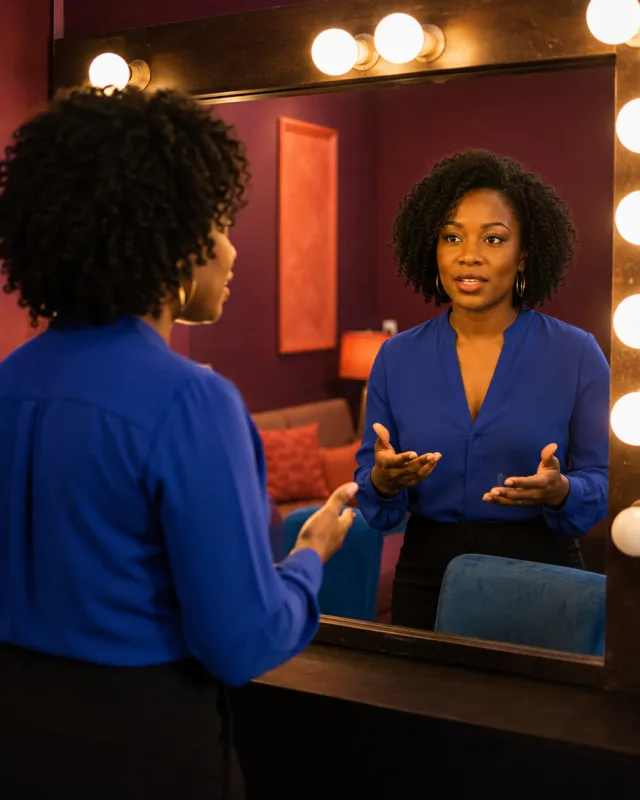
Quiet strength is the capacity to not fill every gap with noise, to let observation and timing carry more weight than speech, and to remain fully present in a conversation without needing to dominate it. In a world engineered for volume, the quiet person is the one whose attention is still theirs to direct, which is why they often see what the loud ones miss.
Everyone talks.
The problem is not that nobody is speaking. The problem is that almost no one is listening, including the people doing most of the talking.
In that environment, the person who can simply stay silent and attentive holds a kind of power most people have forgotten existed.
Why are quiet people often more powerful?
Quiet people are often more powerful because quiet strength processes more information per minute than the person talking. Speaking and thinking are not the same activity. The speaker is committed to a track. The listener is scanning for patterns, gaps, hidden tension, inconsistencies between words and body. The listener ends the conversation with a richer map of the room.
Susan Cain's 2012 book Quiet: The Power of Introverts in a World That Can't Stop Talking argued this explicitly, drawing on decades of research in biology, psychology, and neuroscience. Cain documented what she called "the extrovert ideal," a cultural bias that treats talkativeness as a proxy for leadership, when the research on actual performance shows no such correlation. The book spent eight years on the New York Times bestseller list because it named something a lot of people felt but could not articulate: the quiet person was not the problem.
Quiet strength is not timidity. It is the confidence to not perform. Insecurity fills every silence. Confidence lets silence land. (Related: Silence Is a Weapon.)
How is strategic silence an advantage in negotiation?
Strategic silence is an advantage in negotiation because people are psychologically uncomfortable with pauses and tend to fill them with information, concessions, and revisions the other party did not have to ask for. Professional negotiators are trained to leave space and wait. Amateurs rush to close the silence and discover later that they talked themselves into a worse deal.
The mechanics are specific. After you make an ask, stop. Do not explain, justify, or pre-negotiate with yourself. Let the silence work. The counterparty will either accept, counter, or fill the silence with useful information about why they cannot accept. All three outcomes are better for you than the premature discount you were about to offer. Silence also communicates quiet confidence in your position, which shifts perceived power without either party saying so.
This is one of the most reliable small upgrades available to anyone who negotiates anything (a salary, a contract, a boundary, a scope of work). It costs nothing. It takes minutes to practice. Almost nobody does it, which is why it still works. (Related: Your Word Is Your Bond.)
How do I get comfortable with silence in conversation?
You get comfortable with silence by practicing it in low-stakes settings until the discomfort stops triggering you to speak. The reason most people cannot tolerate silence is not a personality trait. It is a trained reflex, usually built in childhood, that equates pauses with social failure. The reflex can be retrained with repetition, the same as any other reflex.

Start with a 3-second pause after someone finishes speaking, before you respond. Not a dramatic pause. Just enough to receive what they said instead of racing to reply. Build to 5 seconds. Build to the point where silence no longer feels like an emergency you have to end. You will notice that other people often use your pause to add what they actually meant, and the conversation gets better on its own.
Active listening is built on this foundation. Real listening is not waiting for your turn. It is attention directed outward with no plan to interrupt. When you train the pause, you train the listening. When you train the listening, everyone you talk to notices. (Related: Breathe Before You React.)
What does listening reveal that talking cannot?
Listening reveals what the speaker does not know they are saying. Most people cannot accurately describe what they need. They say one thing and mean something adjacent. Quiet strength, practiced as active listening, hears the gap between the stated issue and the real one. That gap is where every important conversation actually lives.
Listening also reveals what is not being said. Silences inside a conversation carry data: the topic avoided, the name not mentioned, the question deflected. A talker is generating output and misses all of this. A listener sees the shape of the conversation, including the parts that were left out on purpose.
The final thing listening reveals is respect. People open up to people who are actually listening, and they close down around people who are performing listening while waiting to speak. If you want honest information from the people around you, be a person worth telling the truth to. The fastest way is to shut up and pay attention. (Related: The Measure of a Person.)
How do I stop filling every gap with noise?
You stop filling gaps by recognizing the urge to fill them as the symptom it is, and by letting the urge pass without acting on it. Quiet strength is the decision to not act on that urge. The urge is not information. It is anxiety dressed up as social obligation. You do not have to speak. You are allowed to let the silence continue.
Lao Tzu's Tao Te Ching, Chapter 56, contains the principle in its oldest form: "Those who know do not speak. Those who speak do not know." Whatever translation you prefer, the observation survives 2,500 years because it keeps being true. People with the most to say are often the quietest. People with the least substance are often the loudest. Assertiveness is not volume; it is the willingness to hold a position without needing to perform it into submission.
Practice small: one meeting per day where you deliberately speak less than usual. Notice what happens. In almost every case, the meeting does not go worse. Often, it goes better, because the room had been drowning in noise that was not load-bearing. (Related: Guard Your Peace.)
Being THE ONE
THE ONE knows when to speak and when to stay quiet.
Not from shyness. From discipline.
THE ONE is not impressed by the loudest voice in the room. THE ONE has noticed that the loudest voice usually has the least to say, and that quiet strength is the signal almost no one else is sending.
Most people fill silence.
THE ONE uses it.
Be the one whose few words carry more weight than everyone else's many.
Sources
- Cain, S. (2012). Quiet: The Power of Introverts in a World That Can't Stop Talking. Crown. NYT bestseller for eight years, translated into 40+ languages. https://susancain.net/book/quiet/
- Lao Tzu. Tao Te Ching, Chapter 56. "Those who know do not speak. Those who speak do not know." Verified across major translations (Ames, Mitchell, Feng). https://en.wikisource.org/wiki/Translation:Tao_Te_Ching
- Voss, C. (2016). Never Split the Difference: Negotiating As If Your Life Depended On It. HarperBusiness. Former FBI lead hostage negotiator on strategic silence. https://www.blackswanltd.com/
- Rogers, C. R., & Farson, R. E. (1957). Active Listening. Industrial Relations Center, University of Chicago. Foundational paper on active-listening practice. https://www.gordontraining.com/free-workplace-articles/active-listening/
Ready to put this into practice? Check your identity alignment and see where you actually stand.