Identity
Everything Is Connected
Systems thinking is the practice of seeing how environment, habits, identity, and outcomes form a single interdependent web. Everything is connected means change one node and the surrounding pattern shifts. Stop treating your life as a collection of separate problems. Start seeing the loops that produce them.

In this article
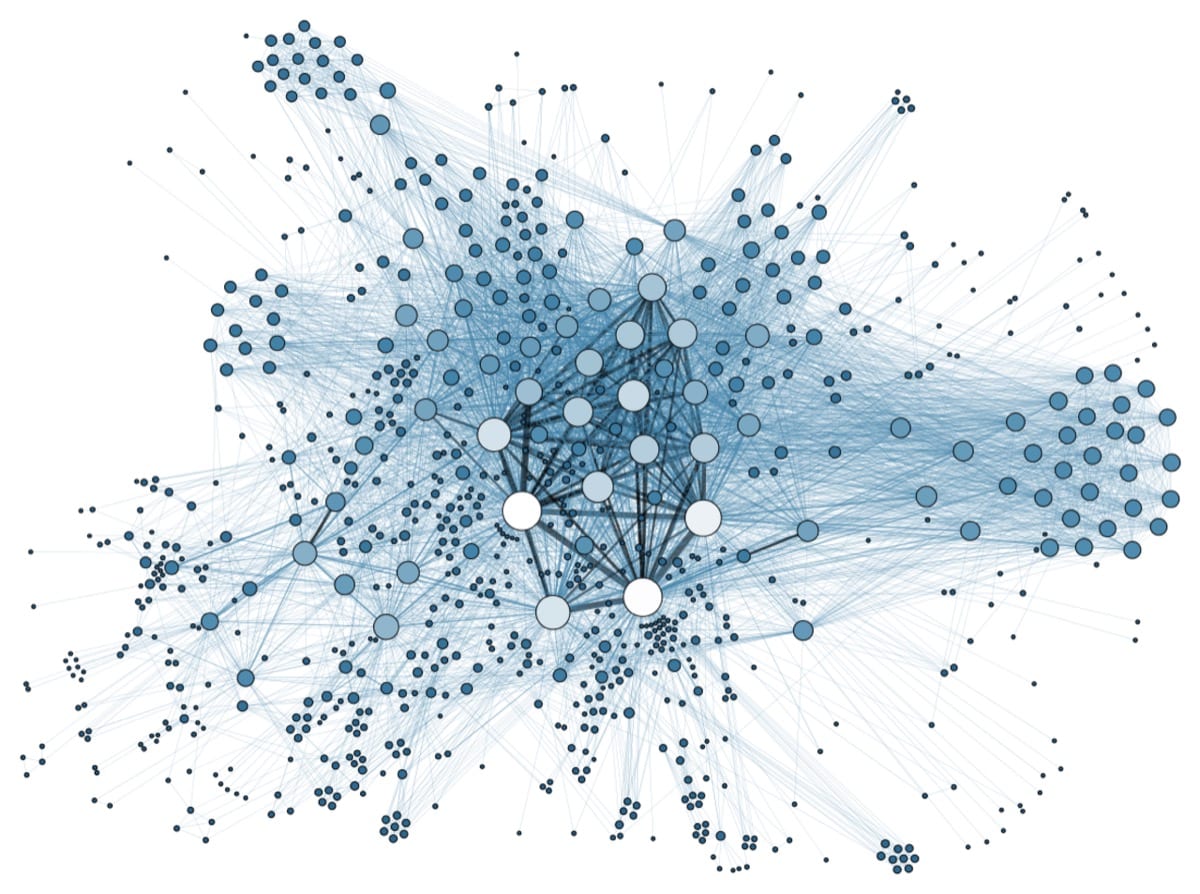
Systems thinking is the practice of seeing how environment, habits, identity, and outcomes form a single interdependent web. Everything is connected means change one node and the surrounding pattern shifts. Stop treating your life as a collection of separate problems. Start seeing the loops that produce them.
The more you read, the more you see connections everywhere.
Because everything is connected. This is not mystical thinking. It is pattern recognition. The threads that link ideas, behaviors, environments, and outcomes become visible when you look for them, and invisible when you do not.
John Muir put it plainly in My First Summer in the Sierra (1911): "When we try to pick out anything by itself, we find it hitched to everything else in the Universe." He was writing about mountains. The sentence lands harder when the thing you try to pick out is your own behavior.
What is systems thinking in practice?
Systems thinking is the discipline of looking at how elements relate and feed back on each other. Donella Meadows, in Thinking in Systems (2008), defined a system as "an interconnected set of elements coherently organized to achieve something." Your life is such a system. Habits are not separate from environment. Identity is not separate from daily actions. Each element feeds the others in loops.
When a problem keeps recurring, the problem is not the event. It is the structure that produces the event. Willpower-based fixes attack the event. Systems-based fixes attack the structure. The first works for a week. The second works for years.
Seeing the system requires stepping back far enough to watch loops unfold. A bad morning is an event. A pattern of bad mornings is a system: late bedtime, phone on nightstand, alarm negotiated down. Attack one element in isolation and the rest pull you back. That pull has a name in systems language: emergence, the behavior the whole loop produces that no single part contains. Environment design on the whole loop is how the system shifts. (Related: Your Environment Shapes You.)
Why does environment beat willpower in every loop?
Environment beats willpower because willpower is finite while environment runs 24 hours a day. The striking evidence comes from Lee Robins's research on Vietnam veterans: roughly 20 percent of U.S. soldiers in Vietnam developed heroin addiction, yet only about 5 percent of those men relapsed within their first year home. The environment that produced the addiction was gone, and most of the addiction went with it.
This finding contradicted everything the medical community expected. Addiction was supposed to be a brain disease that persisted regardless of context. The data said otherwise. Context mattered more than treatment, more than detox, more than willpower. The soldiers who came home were, neurologically, the same people who had been addicted in Vietnam. The environment had changed, and with it, the addiction.
The implication for ordinary life is enormous. If environmental change can break one of the most powerful addictions known, environmental change can break your scrolling habit, your snacking habit, your procrastination habit. Stop trying to white-knuckle through bad environments. James Clear compressed the whole argument into two lines in Atomic Habits (2018): "You do not rise to the level of your goals. You fall to the level of your systems." Redesign the environment and the behavior often follows automatically. (Related: The Dopamine Trap.)
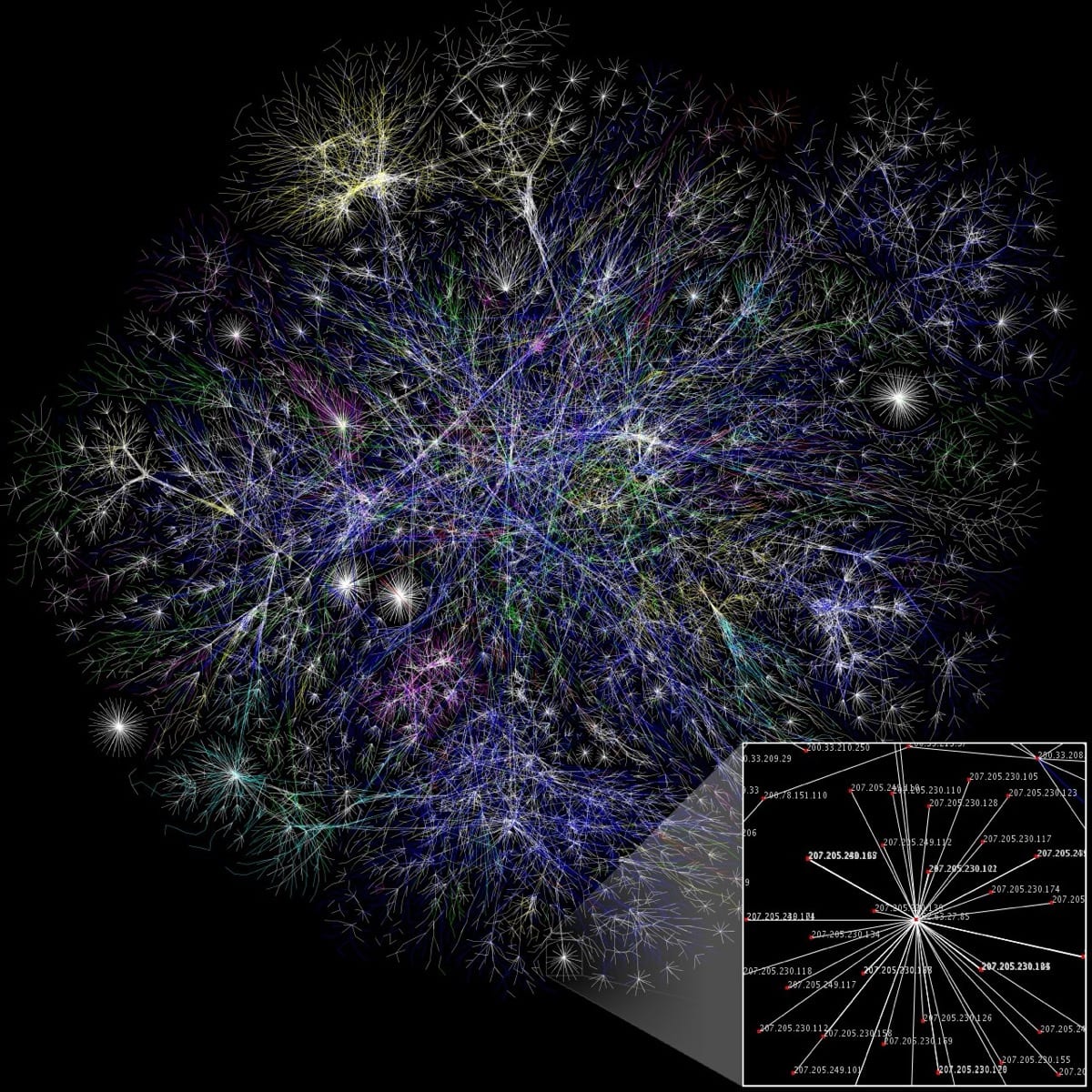
How do feedback loops shape identity over time?
Feedback loops shape identity over time because actions generate evidence, evidence updates self-concept, self-concept generates more actions. Wendy Wood and David Neal's 2007 paper "A New Look at Habits and the Habit-Goal Interface" in Psychological Review documented that automatic habits form through context-cued repetition. Every repetition strengthens the loop. Every break weakens it. The loop is the unit that actually determines who you become.
The loops run in both directions. A reinforcing loop (exercise feels good, you do more, you feel better about yourself, you exercise more) spirals upward. A balancing loop (skipping feels easy, you skip more, you feel worse about yourself, skipping becomes harder to break) spirals downward. Same person. Different loops. Different lives.
Most of daily life already runs on these loops. Diary studies by Wood, Quinn, and Kashy (2002) in the Journal of Personality and Social Psychology found that about 43 percent of everyday actions are performed out of habit, in the same context, day after day. Nearly half your day is loop output.
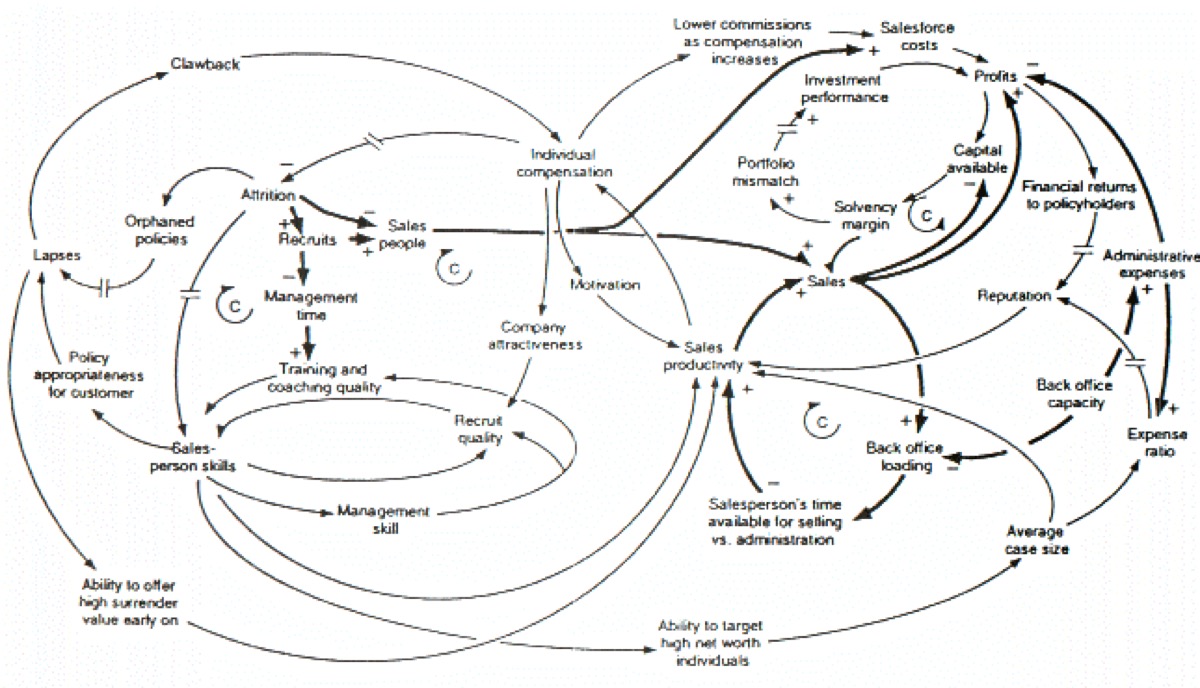
Trace one loop node by node. The phone charges on the nightstand. So you scroll late. So you sleep short. So your willpower runs low the next evening. So you scroll again, later this time. Five nodes, one circle, and every pass around it tightens the next. Sketch that circle on paper with arrows and you have drawn a causal loop diagram, the basic unit of systems mapping. (Related: The Compound Identity.)
The intervention point is the loop, not the willpower. Insert a better cue. Remove the trigger for the unwanted behavior. Add friction to the easy-but-costly option. Reduce friction on the hard-but-valuable one. These are structural changes, and structural changes propagate through the entire loop. Pattern recognition lets you see where the leverage point actually lives. (Related: Your Habits Are Your Future.)
Where are the highest-leverage points in my life systems?
The highest-leverage points are usually the ones furthest from the visible problem. If the problem is energy, the leverage point may be sleep. If focus, phone location. If anxiety, information diet. Meadows ranked twelve leverage points in order of power, with the most powerful being structural: paradigms, goals, and rules of the system.
She laid out the full ranking in her 1999 essay "Leverage Points: Places to Intervene in a System." The practical audit is simple. For each recurring problem in your life, ask: what system is producing this? Not who is to blame. What structure. Then ask: what is the smallest structural change that would alter the loop? Often the answer is physical (move the phone), sometimes it is social (reduce contact with a specific person), sometimes it is informational (unsubscribe from specific feeds). Rarely is it motivational. (Related: Motivation Is a Liar.)
Meadows also gave you the vocabulary for the audit: stocks and flows. Your energy is a stock. Sleep and stress are the flows that fill and drain it. Chasing the stock directly gets you nowhere. Change the flows and the stock takes care of itself.
Awareness is the precursor to change. Most people move through life unaware of the patterns, reacting without understanding the system, struggling against effects while ignoring causes. Seeing the loops is what lets you modify them. Without that sight, you are subject to structural forces you did not know were operating. With it, you can redesign your own life architecture deliberately. (Related: Simplify Your Life.)
What is the iceberg model in systems thinking?
The iceberg model is a systems thinking tool with four levels: events on the surface, then patterns, structures, and mental models underneath. You see the event. The system is nine-tenths underwater. Each level down explains more and is harder to spot, and changes made at deeper levels outlast changes made at the surface.
Run the bad morning through it. Event: you hit snooze four times and skipped the gym. Pattern: it happens most weeks, always after a late night. Structure: the phone charges on the nightstand and nothing shuts the evening down. Mental model: the belief that late hours are the only hours that belong to you. Four levels, one problem.
Most people respond at the event level, which is why the fix never holds. Deeper levels give more leverage. Correct the mental model and the structures, patterns, and events reorganize themselves around it. (Related: The Story You Tell Yourself.)
How do I start seeing systems instead of events?
Start seeing systems by asking, for any event, "what pattern is this part of?" An argument with a partner is rarely just one argument. A skipped workout is rarely just one skip. Each is the visible tip of a recurring dynamic. Events are data points. Systems are the equations that produce them.
The practical habit is to keep a pattern journal. Once a week, write down three events from the past seven days and ask: is this a pattern? What is the full loop that produces this kind of event? What would change the loop rather than just handle today's instance? That journal is systems mapping in its cheapest form. Over weeks, the loops start becoming visible without effort. Your brain learns to recognize structural patterns instead of getting lost in individual events.
Reading accelerates the skill. Each book adds mental models. Each idea adds a node in your network of understanding. Peter Senge's 1990 The Fifth Discipline and Meadows' Thinking in Systems are the two most useful primers for developing the pattern-recognition muscle that systems thinking requires. Read them. The ROI, in years of wasted effort avoided, is substantial. (Related: Clean Up and Focus.)
Frequently Asked Questions
What is the difference between linear thinking and systems thinking?
Linear thinking looks for a straight line from cause to effect: A broke B, so fix A. Systems thinking looks for circles: A feeds B, B feeds C, and C loops back into A. Linear thinking asks who broke it. Systems thinking asks what structure keeps producing it. For one-off problems, linear works fine. For recurring ones, the loop is the answer.
What is a causal loop diagram?
A causal loop diagram is a sketch of a feedback loop. Each variable is a node, each arrow shows what pushes on what, and the arrows close into a circle. Drawing one takes five minutes with a pen. The value is that a loop on paper is much harder to argue with than a loop in your head.
What is an example of systems thinking in everyday life?
Weeknight takeout. The event is ordering food again. The pattern is every stressful weekday. The structure is an empty fridge, no meal plan, and a delivery app on the home screen. Delete the app and shop on Sunday, and the "discipline problem" mostly disappears. The behavior was never the problem. The system was.
How long does the pattern journal take to work?
Give it a month. Most personal loops repeat on a weekly cycle, so four or five entries usually capture two or three full passes of the same loop. That is enough to name the pattern and pick one structural change. The writing takes about ten minutes a week. The seeing compounds from there. (Related: The Daily Audit.)
Being THE ONE
THE ONE sees the connections.
Does not treat life as a collection of separate problems. Sees the systems. Sees the patterns. Sees how everything relates to everything else.
THE ONE designs environments intentionally. Knows that environment shapes behavior, and creates spaces that support desired outcomes instead of undermining them.
THE ONE builds habits that build identity. Understands the loop. Chooses actions that create the person they want to become, one evidence point at a time.
The more you read, the more you see connections.
Because everything is connected.
Be the one who sees the patterns.
Be the one who designs environments deliberately.
Be the one who understands that habits, identity, systems, and outcomes are all linked.
Everything is connected.
Use this knowledge.
Sources
- Meadows, D. H. (2008). Thinking in Systems: A Primer. Chelsea Green Publishing. Foundational framework for seeing systems, loops, and leverage points. https://www.chelseagreen.com/product/thinking-in-systems/
- Meadows, D. H. (1999). Leverage Points: Places to Intervene in a System. The Sustainability Institute. Primary text of the twelve-point leverage ranking. https://donellameadows.org/archives/leverage-points-places-to-intervene-in-a-system/
- Robins, L. N., Helzer, J. E., Hesselbrock, M., & Wish, E. (2010). "Vietnam Veterans Three Years After Vietnam: How Our Study Changed Our View of Heroin." American Journal on Addictions, 19(3), 203-211. The environment-breaks-addiction finding. https://pubmed.ncbi.nlm.nih.gov/20374215/
- Wood, W., & Neal, D. T. (2007). "A new look at habits and the habit-goal interface." Psychological Review, 114(4), 843-863. On context-cued habits and automatic behavior. https://psycnet.apa.org/record/2007-15390-001
- Wood, W., Quinn, J. M., & Kashy, D. A. (2002). "Habits in everyday life: Thought, emotion, and action." Journal of Personality and Social Psychology, 83(6), 1281-1297. Diary-study source of the 43 percent habit figure. https://doi.org/10.1037/0022-3514.83.6.1281
- Senge, P. M. (1990). The Fifth Discipline: The Art and Practice of the Learning Organization. Doubleday. On systems thinking in organizations and individuals. https://www.penguinrandomhouse.com/books/163984/the-fifth-discipline-by-peter-m-senge/
- Muir, J. (1911). My First Summer in the Sierra. Houghton Mifflin. Full text at the Sierra Club John Muir Exhibit, which documents the verified wording of the "hitched to everything else" line. https://vault.sierraclub.org/john_muir_exhibit/writings/my_first_summer_in_the_sierra/
Ready to put this into practice? Take the Shadow vs Phoenix assessment and see where you actually stand.