Identity
Why You Wear a Mask Around Others and How to Stop
Wearing a social mask can protect belonging, privacy, or safety, but constant performance can leave you exhausted and unsure which responses are actually yours. Learn the difference between a normal social role, identity covering, and neurodivergent masking, then use a six-step plan to unmask selectively and safely.

In this article
Wearing a mask around others means editing, suppressing, or performing parts of yourself to gain acceptance, meet a role, protect privacy, or stay safe. Some adjustment is normal. The problem begins when the performance becomes automatic, exhausting, opposed to your values, and impossible to set down even with people who have earned your trust.
You built the mask for a reason.
Maybe it earned approval. Maybe it prevented conflict. Maybe it kept a vulnerable part of you out of reach.
Dropping the persona does not mean exposing everything to everyone. It means recovering choice.
What does it mean to wear a mask around other people?
Wearing a mask means presenting a socially acceptable version of yourself while concealing feelings, needs, traits, opinions, or behaviors that seem risky to reveal. It can be conscious, such as acting composed in a meeting, or automatic, such as agreeing before you have checked what you actually want.
Carl Jung used persona for the social face that helps a person meet the demands of the world. A parent, leader, doctor, friend, and employee naturally use different parts of themselves in different rooms. Flexibility is healthy. Fusion is the issue: the role becomes a problem when you mistake it for the whole self or cannot take it off.
Several related ideas are often collapsed into the word "masking," but they are not identical:
| Pattern | What it means | When it becomes costly |
|---|---|---|
| Social role | Adjusting behavior to fit a context | The role violates values or never switches off |
| Identity covering | Downplaying a known identity to fit a dominant norm | Belonging depends on concealment |
| Emotional labor | Displaying an expected emotion at work | Surface acting creates sustained dissonance |
| Neurodivergent masking | Hiding or compensating for autistic or ADHD traits | Continuous monitoring, suppression, or assimilation harms well-being |
| Privacy | Choosing what others have earned access to | It becomes isolation rather than a boundary |
The goal is not to eliminate every role. It is to know when you are choosing one. In social mask psychology, the useful distinction is flexibility versus compulsion, not public versus private. How to Find Yourself helps separate a useful role from an inherited identity that has started running without permission, while The Story You Tell Yourself helps expose the narrative that keeps the role in place.
Why do you hide your true self around others?
You usually hide your true self because your system predicts a cost for being seen. The predicted cost may be rejection, ridicule, punishment, job loss, conflict, stereotyping, or the withdrawal of love. That prediction can come from current reality, past learning, or both.
Common reasons include:
- Belonging: the group rewards sameness and punishes difference.
- Safety: honesty has previously brought anger, abuse, discrimination, or retaliation.
- Approval: being useful, easygoing, funny, strong, or successful became the route to closeness.
- Role pressure: work or family assigned you a narrow function and stopped making room for the rest.
- Unclear self-concept: after years of adaptation, you know what the room expects faster than what you want.
- Neurodivergence: suppressing stims, scripting conversation, forcing eye contact, or copying social behavior may help navigate a world built around different norms.
The mask is not evidence that you are dishonest. It is often evidence that you learned quickly. Treat it as an adaptation before treating it as a problem. Compassion makes honest review possible; contempt only teaches the mask to hide more efficiently. (Related: Stop People Pleasing and Stop Abandoning Yourself.)
How do you know when the mask is costing you?
The clearest sign is loss of choice. You keep performing even when the room is safe, the role is over, and the performance leaves you depleted. Wearing a mask around others has become costly when approval depends on repeated self-contradiction and there is no trusted setting in which your nervous system can stop monitoring the performance.
Look for patterns rather than one isolated moment:
- You rehearse ordinary conversations and review them afterward for mistakes.
- Social contact leaves you disproportionately exhausted.
- Different groups know versions of you that could not comfortably meet.
- You agree, smile, or reassure while resentment rises underneath.
- You cannot name preferences until you see what everyone else wants.
- Praise feels strangely empty because it lands on the performed version.
- You feel relief only when alone, followed by uncertainty about who you are without an audience.
- Safe people describe you as guarded, unreadable, or different in every room.
The Deloitte and NYU report Uncovering Talent found that 61% of surveyed employees reported covering at least one aspect of identity at work. That workplace statistic does not mean every act of professionalism is harmful. It shows how common it is for people to manage visibility in response to norms and perceived consequences.
Research on emotional labor adds a useful mechanism. A 2025 meta-analysis of 27 observational studies found that high-exhaustion forms, including surface acting and emotional dissonance, were associated with poorer mental-health outcomes. Association is not proof that performance caused every outcome, but it supports taking chronic internal-external conflict seriously.
Is a social mask always unhealthy?
No. A social mask can be a boundary, a professional tool, a source of play, or a necessary protection. You do not owe full access to coworkers, strangers, unsafe relatives, or anyone who has not earned your trust.
Healthy role management is flexible. You can become more formal at work, steadier during a crisis, or more private in a new relationship without abandoning yourself. The role remains connected to your values and can be set down afterward.
Use three tests:
| Test | Healthy flexibility | Costly masking |
|---|---|---|
| Choice | "I am choosing what to reveal here" | "I cannot stop performing" |
| Recovery | The role comes off in safe spaces | There is nowhere to rest |
| Values | The role expresses a real part of you | The role repeatedly violates what matters |
Authenticity is not saying every thought out loud. It is a workable alignment between awareness, values, behavior, and relational honesty. Your authentic self still has privacy, tact, roles, and boundaries. Sutton's meta-analysis found a strong overall relationship between authenticity and well-being across the included studies, while also warning that much of the evidence relies on Western, individualist ideas of authenticity. Context and culture matter. Guard Your Peace offers a useful boundary when openness would only create more exposure.
Is this the same as autistic or ADHD masking?
Not exactly. In neurodivergent communities, masking or camouflaging has a specific meaning: consciously or unconsciously hiding traits, mimicking neurotypical behavior, scripting interaction, suppressing stimming, forcing eye contact, or tolerating sensory strain to fit expected norms.
That experience should not be reduced to ordinary politeness or a Jungian metaphor. A 2024 meta-ethnography of 13 qualitative studies described camouflaging as a response to stressful social contexts and found that cognitively demanding, highly monitored, or habitual strategies appeared especially connected to poor mental health. The authors also emphasized the social environment: the burden does not sit only inside the person masking.
If you suspect autism or ADHD, this article cannot diagnose it. A neurodiversity-affirming clinician can help you explore traits, accommodations, burnout, and safer ways to reduce masking without demanding sudden exposure. Unmasking is not a performance assignment either.
How do you stop masking your personality safely?
If you want to know how to stop masking your personality safely, start gradually, selectively, and in places where the likely cost is acceptable. The objective is not "tell everyone everything." It is "make the gap between the inside and outside smaller where safety permits." Wearing a mask around others may still be protective in a genuinely unsafe setting; choice and safety come before disclosure.
1. Map the mask by context
For one week, note where the performance appears:
| Situation | What I displayed | What I felt or needed | What I feared would happen | Energy cost 1-5 |
|---|---|---|---|---|
| Example: team meeting | Immediate agreement | More time to think | Looking difficult | 4 |
Do not force change during the observation week. Awareness is the first recovery of choice. The Daily Audit gives this practice a simple evening structure.
2. Identify the mask's job
Ask what the mask protects: employment, physical safety, belonging, privacy, a relationship, or an old expectation that may no longer be true. Different jobs require different responses. A realistic threat needs a boundary or safer environment. An outdated prediction can be tested gently.
3. Choose one low-risk truth
Start below the level of confession. State a preference. Ask for time. Decline a minor request. Say, "I do not understand yet," "I need a quiet break," or "Let me think before I answer." A small honest response gives you new data about the room. The Pause Before You Speak creates the few seconds needed to find that response.
4. Use a disclosure ladder
Rank people and situations by safety rather than importance:
- Private: admit the truth to yourself or in a journal.
- Low risk: express a preference where disagreement has little cost.
- Trusted: share a need with someone who has responded well before.
- Negotiated: request a boundary or accommodation.
- High stakes: disclose only with preparation, support, and a clear reason.
Skipping directly to high-stakes disclosure can recreate the danger that built the mask. Gradual practice lets trust earn access.

5. Replace performance with a boundary
Sometimes the answer is not more vulnerability. It is less access. You can stop pretending to enjoy a harmful conversation without revealing your entire history. You can leave, shorten the visit, change the subject, or say no. Boundaries Are Not Walls shows how protection and connection can coexist; Say What You Mean helps make the boundary clear without turning it into a confession.
6. Review the result, not the fear alone
After the experiment, ask: What was the prediction? What happened? Did the response leave you more grounded, more exposed, or both? Was the other person curious, dismissive, punishing, or trustworthy? Use the answer to choose the next step.
The video below expands the related Jungian idea of shadow work: turning toward parts of yourself that were pushed out of the acceptable persona. Use it as reflection, not diagnosis.
What is the difference between the true self and the false self?
Donald Winnicott used "True and False Self" to describe how spontaneous self-expression can be protected by a compliant presentation that responds to environmental demands. The false self was not simply a lie; in Winnicott's account, it could serve a defensive and protective function.
Modern readers should be careful not to turn that theory into a purity test. You do not have one perfectly authentic core and a collection of fake roles. People are contextual, relational, and capable of genuine multiplicity. Wearing a mask around others becomes a problem when the role requires repeated self-abandonment, not simply because different contexts reveal different parts of you. Identity Is Not a Feeling helps ground that distinction in patterns and choices.
If you can use the role and put it down, it is a tool. If every relationship depends on it, the tool has become the room you live in. Meet Your Shadow helps examine what the accepted version had to exclude.
FAQ
Is masking the same as lying?
No. Masking may involve concealment or performance, but it often develops to manage safety, belonging, stigma, privacy, or role expectations. Deliberate deception for advantage is different from adapting under perceived social cost. The impact still deserves review even when the motive was protective.
How can you tell which version of you is real?
Look for values and preferences that remain relatively consistent across privacy, time, and safe relationships. Treat the answer as a pattern, not a single feeling. Every context reveals a part of you; the issue is whether any context lets you act without chronic self-contradiction.
Do you have to unmask at work?
No. Workplaces contain real power differences and consequences. Decide what outcome you need, what disclosure is necessary, and whether a boundary or accommodation can meet that need with less exposure. Full authenticity is not an employment requirement.
When should you seek professional support?
Consider support when masking is tied to severe anxiety, depression, burnout, trauma, identity confusion, self-harm thoughts, suspected neurodivergence, or relationships in which being honest feels dangerous. Choose a clinician who understands the relevant context and does not treat forced disclosure as the goal.
Being THE ONE
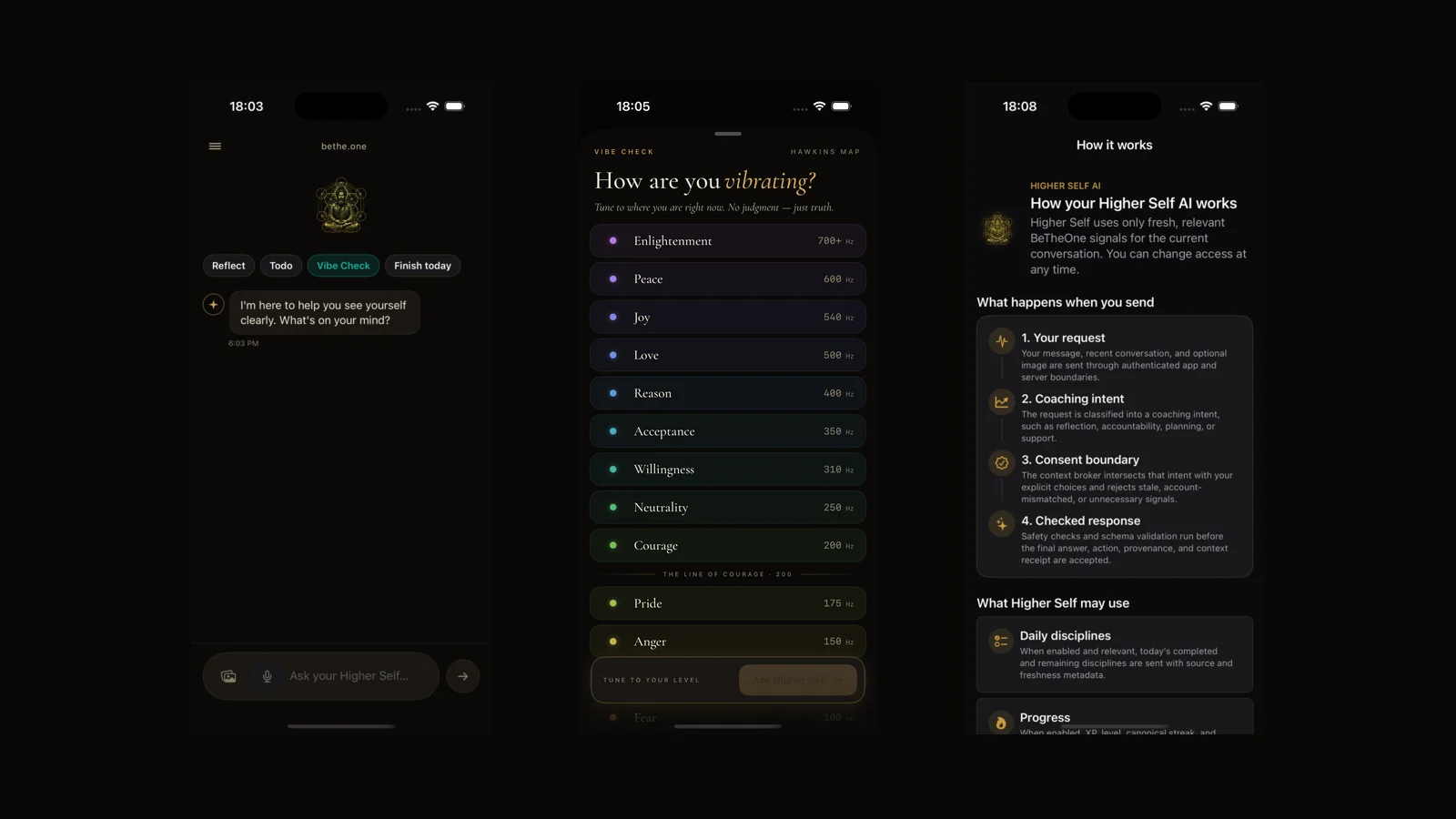
How Be The One can support safer unmasking
Be The One should treat authenticity as a private direction, not a public performance requirement. A user can name the values of a Higher Self, notice where a social role becomes costly, and choose one low-risk truthful action. The system should never assume that disclosure is safe or that less masking is automatically better in every context.
The Be The One choice-before-disclosure loop
- Private directionDefine the values to protect without publishing a personal identity
- Context checkNotice the people, places, and power dynamics around the mask
- Small truthChoose one low-risk preference, feeling, or honest response
- BoundaryUse a clear limit when disclosure would create danger or unwanted exposure
- ReflectionReview what actually happened and adjust the next choice
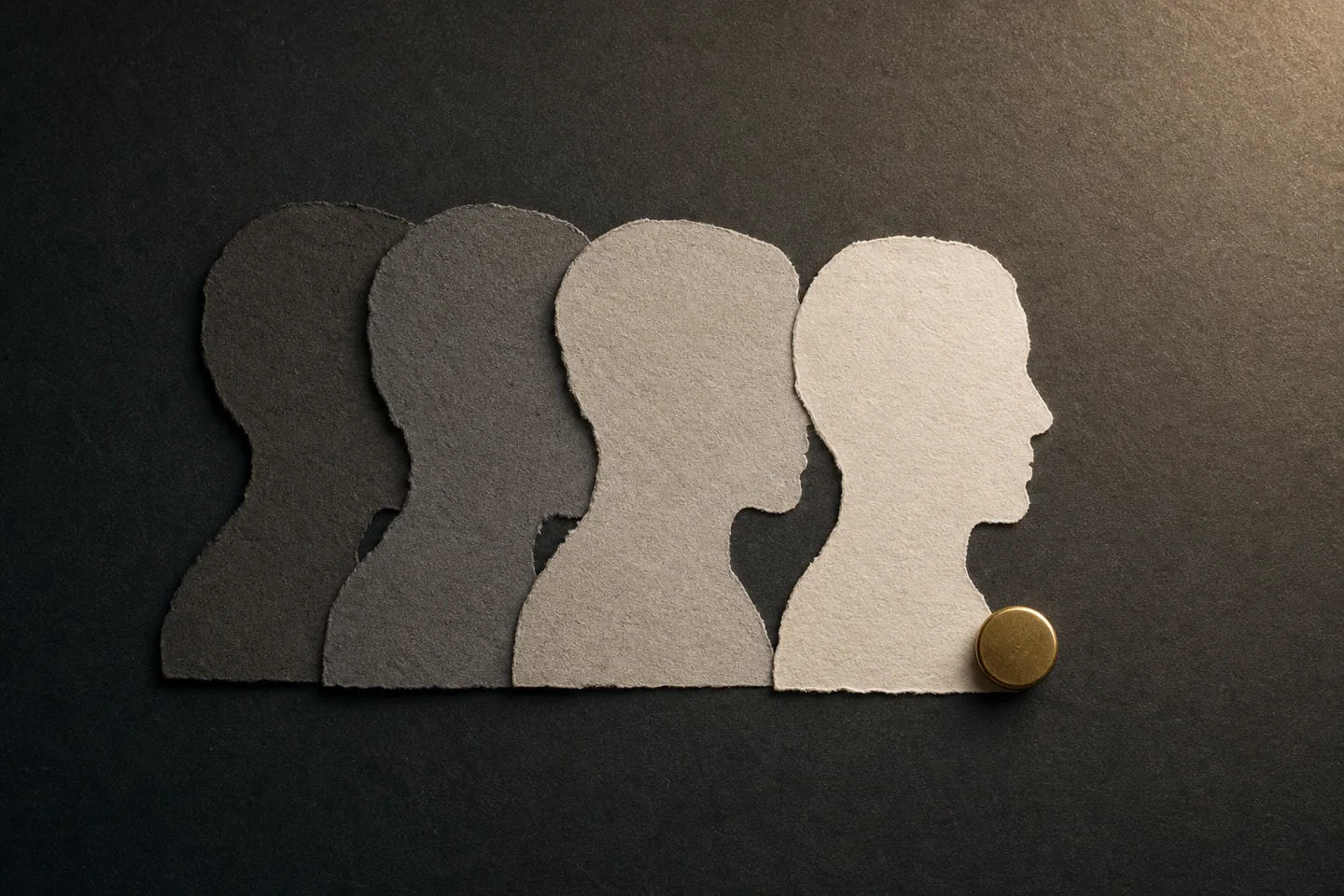
Authenticity is not measured by how much you reveal. It is measured by whether the choice remains yours.
AI coaching can offer a context-audit prompt or help draft a boundary, but it should not diagnose masking, select a “real self,” or urge disclosure. XP should attach only to a user-chosen action such as stating a preference or protecting a limit—never to sharing sensitive information. Community features require the same consent and safety standard. This is where a whole-person identity system must remain subordinate to the person using it.
THE ONE does not perform for automatic approval.
But THE ONE also does not confuse exposure with courage.
Uses a role when the work requires it. Uses a boundary when safety requires it. Lets trusted people meet the version that can breathe.
The point is not to destroy the mask.
The point is to recover the hand that chooses when to lift it and when to set it down.
Be the one who makes honesty safer, smaller, and more consistent until the real response has room to enter.
Sources
- Jung, C. G. (1953). Two Essays on Analytical Psychology (Collected Works, Vol. 7). Princeton University Press. The persona as a social face or mask. https://books.google.com/books?vid=ISBN9780691017822
- Winnicott, D. W. (1960/1965). "Ego Distortion in Terms of True and False Self." In The Maturational Processes and the Facilitating Environment. The protective and compliant functions of the false self. https://academic.oup.com/book/1192/chapter/140028848
- Smith, C., & Yoshino, K. (2013). Uncovering Talent: A New Model of Inclusion. Deloitte University Leadership Center for Inclusion / NYU School of Law. Identity covering at work. https://www.law.nyu.edu/news/kenji-yoshino-explores-the-cost-of-conformity-at-work
- Sutton, A. (2020). "Living the Good Life: A Meta-Analysis of Authenticity, Well-Being and Engagement." Personality and Individual Differences, 153, 109645. Relationship between authenticity and well-being, with cultural limitations. https://doi.org/10.1016/j.paid.2019.109645
- Gao, Y., et al. (2025). "The Impact of Emotional Labor on Mental Health: A Systematic Review and Meta-Analysis of Multi-Occupational Groups." Acta Psychologica, 105905. Surface acting, emotional dissonance, and mental-health associations. https://pubmed.ncbi.nlm.nih.gov/41207128/
- Williams, Z. J., et al. (2024). "A Meta-Ethnography of Autistic People's Experiences of Social Camouflaging and Its Relationship With Mental Health." Autism. Thirteen-study qualitative synthesis. https://pmc.ncbi.nlm.nih.gov/articles/PMC11134975/
- Cleveland Clinic. (2024). "What Is Masking? And What's the Harm?" Clinician-reviewed distinction between ordinary social adjustment and autistic masking. https://health.clevelandclinic.org/what-is-masking
Want to see where your public role and private values diverge? Check your identity alignment and review the gap without judgment.