Daily practice
Cold Water Teaches
Cold exposure is not about the cold. It is about voluntary discomfort, practiced daily, until the habit of staying when every instinct screams to run becomes the default response. Cold water teaches exactly one thing, and the one thing is worth more than any health benefit the practice also happens to produce.

In this article
Cold exposure is not about the cold. It is about voluntary discomfort, practiced daily, until the habit of staying when every instinct screams to run becomes the default response. Cold water teaches exactly one thing, and the one thing is worth more than any health benefit the practice also happens to produce.
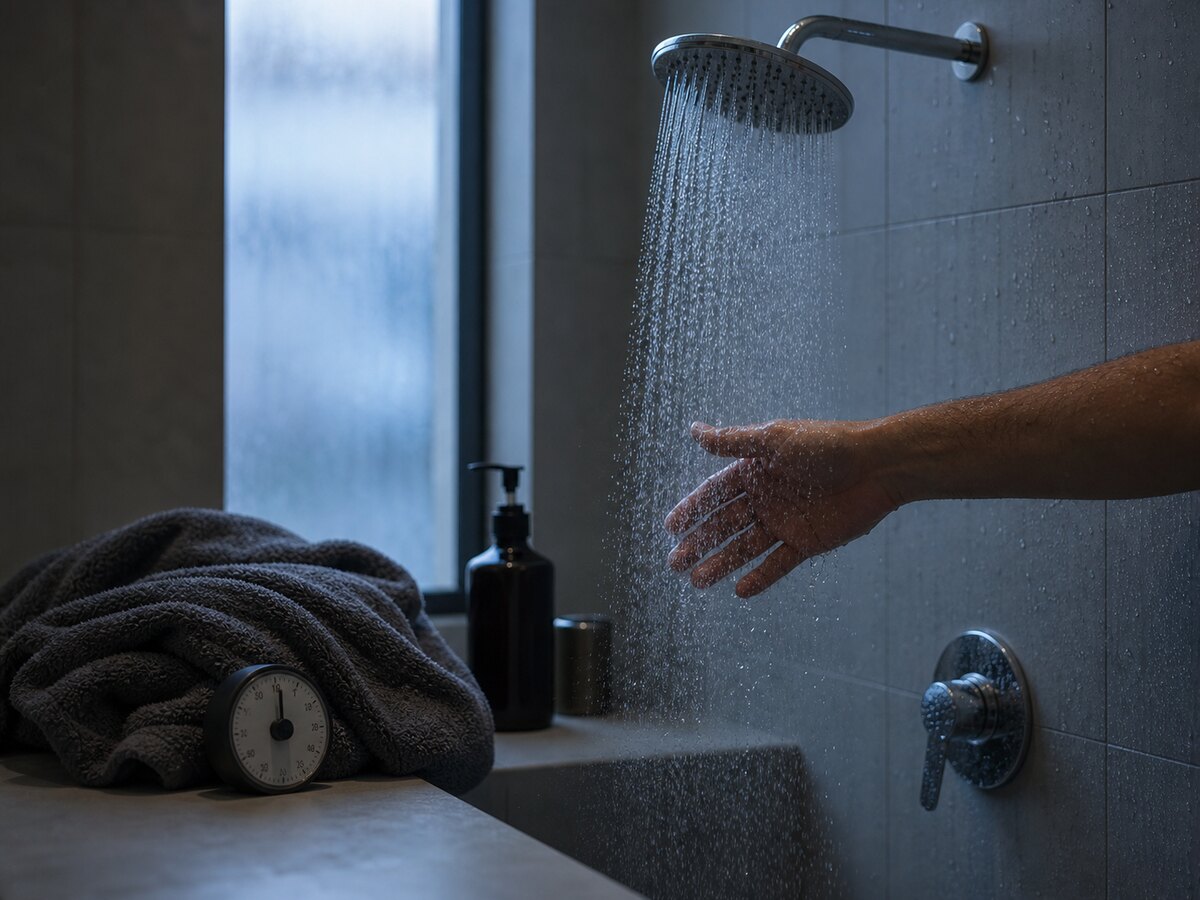
The shower handle turns to cold.
The body tightens. The breath catches. Every instinct says escape. The next thirty seconds are the entire practice. Whether you stay or flinch away is what the water is actually measuring, and it measures you accurately every time.
What does cold exposure actually teach you?
Cold exposure teaches you that the catastrophic narrative your mind produces under stress is almost always wrong. In the first five seconds, your mind generates the story: "This is unbearable. Get out. You do not need this." Thirty seconds later, the story is revealed as false. The discomfort remains, but it is not unbearable. It is just uncomfortable. The gap between the narrative and the reality is the entire lesson.
That gap shows up everywhere. The difficult conversation your mind predicted would go badly almost never goes as badly as predicted. The email you dreaded writing takes ten minutes instead of the hours of anxiety that preceded it. Cold water shows you this pattern in miniature, repeatedly, so cleanly that you start recognizing it in every other domain where discomfort tries to stop you from acting.
The transfer effect is real and fast. Within weeks of a daily cold shower practice, most people notice changes in adjacent behaviors: the difficult email gets sent sooner, the hard workout gets started, the awkward conversation gets had. The point is not training cold tolerance. It is training the meta-skill of overriding the instinct to avoid discomfort, which is useful in a dozen places the cold itself will never touch. (Related: Make Discomfort a Practice.)
What is the real point of a cold shower?
The real point of a cold shower is voluntary discomfort, scheduled daily, in a form you cannot negotiate your way out of. The cold does not listen to reasons. You are either under the water or you are not. That binary is what makes the practice reliable: no ambiguity about whether you did it.
The psychology is the lever, not the physiology. Standing under cold water for 30 to 90 seconds teaches your nervous system that the panic signal is a prediction, not a verdict. You feel the scream. You stay anyway. Breath slows. Body adjusts. Mind quiets. The entire sequence is a template for how to behave when life hands you something harder than a shower, which it will, repeatedly, for the rest of your life.
This is also why the practice needs to be voluntary. Cold forced on you is trauma. Cold you choose, daily, while retaining the option to stop, is training. The psychological content is opposite even though the physical stimulus is similar. Discomfort tolerance compounds only when discomfort is chosen, which is why the morning shower works and the accidentally freezing office does not. (Related: Breathe Before You React.)
How do I start cold exposure safely?
Start with 30 seconds at the end of your normal warm shower, on the coldest setting your fixture can produce. Breathe slowly through the shock: inhale through the nose, long exhale through the mouth. Stay for 30 seconds. Get out. That is a complete session. You do not need an ice bath, a plunge tub, a biohacking subscription, or a coach. The shower handle you already own is enough.
The progression is boring by design. Week one: 30 seconds. Week two: 45 seconds. Week three: 60 seconds. Week four: 90 seconds. Most people cap at 2 to 3 minutes, which captures most of the benefit without the diminishing returns or the risk that comes with longer exposures. There is no benefit to going harder faster. The daily consistency matters much more than the peak duration.
Two contraindications matter: a history of cardiac arrhythmia or heart disease, and acute illness with a high fever. If either applies, talk to your doctor before starting. For everyone else, the risk profile of a 30-second cold shower is extremely low. The practice is one of the most accessible discipline trainers available, with no equipment cost and no schedule conflict. (Related: The Morning Routine for Burnout Recovery.)
What's the science behind cold exposure?
The hormonal response to cold water immersion is striking. Šrámek and colleagues' 2000 study in the European Journal of Applied Physiology measured a 530 percent increase in plasma noradrenaline and a 250 percent rise in plasma dopamine in young men immersed in 14°C water for one hour. The norepinephrine spike arrives within minutes without the crash that follows caffeine.
A 2023 imaging study in Biology (Yankouskaya et al.) examined short head-out cold water immersion and found increased interaction between large-scale brain networks, including the default mode, salience, and central executive networks. The downstream effect was a measurable improvement in reported positive affect after the session. The mechanism seems to be a reset of baseline arousal toward a more alert, mood-positive state that lasts hours.
These findings explain the subjective reports without being the point of the practice. The shower will not cure depression, make you lose weight, or replace a gym. It will reliably shift your first hour toward a more alert, more regulated baseline, and it will train the psychological skill of tolerating discomfort. Both effects compound across months. Neither requires you to believe in the practice for it to work. (Related: The Dopamine Trap.)
Why does cold water build mental toughness?
Cold water builds mental toughness because it provides a daily, non-negotiable rehearsal of the one skill that separates people who follow through from people who do not: acting against an instinct that is telling you to stop. The instinct to avoid cold is fast, loud, and physiological. Overriding it a few hundred times builds a specific neural pathway that generalizes to other contexts where a similar instinct appears.
The generalization is not mystical. It is pattern recognition. Your nervous system accumulates reps of "felt the urge to avoid, did not avoid, survived fine" in the cold shower. When a work situation triggers the same urge-to-avoid signal, the system has a recent memory of ignoring it safely. The response threshold for compliance with the avoidance signal rises, because your evidence base now includes many instances of the signal being wrong.
Seneca wrote in Letters to Lucilius, Letter 18: "Set aside a number of days, during which you shall be content with the scantiest and cheapest fare, with coarse and rough dress, saying to yourself the while: 'Is this the condition that I feared?'" The Roman Stoic called this practice praemeditatio malorum, the premeditation of evils. Cold water teaches the same lesson: rehearse discomfort on purpose, in small doses, so that its actual arrival finds you unafraid. (Related: Make Discomfort a Practice.)
Being THE ONE
THE ONE turns the handle.
Not because cold exposure is fashionable. Because voluntary discomfort, practiced daily, is the cheapest discipline trainer available.
THE ONE knows cold water teaches one thing: the catastrophic narrative is almost always wrong, and staying through it is how you learn to trust your own capacity.
THE ONE treats the shower as a laboratory for the moments in life when discomfort is not optional. Feel the instinct. Stay anyway. Breathe through the shock. Let the reality of it replace the story about it.
The handle is right there every morning.
Thirty seconds is all it asks for.
Be the one who stays.
Be the one whose first decision of the day is to do the hard thing on purpose.
Sources
- Šrámek, P., Šimečková, M., Janský, L., Šavlíková, J., & Vybíral, S. (2000). "Human physiological responses to immersion into water of different temperatures." European Journal of Applied Physiology, 81(5), 436-442. Foundational study documenting 530% norepinephrine and 250% dopamine increases. https://pubmed.ncbi.nlm.nih.gov/10751106/
- Yankouskaya, A., Williamson, R., Stacey, C., Totman, J. J., & Massey, H. (2023). "Short-Term Head-Out Whole-Body Cold-Water Immersion Facilitates Positive Affect and Increases Interaction between Large-Scale Brain Networks." Biology, 12(2), 211. Neuroimaging study on cold immersion and brain network interaction. https://pmc.ncbi.nlm.nih.gov/articles/PMC9953392/
- Seneca. Letters to Lucilius, Letter 18. On praemeditatio malorum, rehearsing discomfort on purpose. https://en.wikisource.org/wiki/Moral_letters_to_Lucilius/Letter_18
- Moffitt, T. E., et al. (2011). "A gradient of childhood self-control predicts health, wealth, and public safety." PNAS, 108(7), 2693-2698. On the long-term value of self-control across domains. https://www.pnas.org/doi/10.1073/pnas.1010076108
Make room for the practice. Plan your weekly practice time and see how the sessions add up.