Daily practice
Invest in Yourself
To invest in yourself is to compound small daily practices into a different person over years. Morning light, an earlier wake, cold water, journaling, reading. Not one grand gesture, but the boring, repeated work of showing up until it holds.

In this article

To invest in yourself is the quietest decision you will ever make and the one that changes everything. Not a course you buy once. A set of small daily practices you repeat until they compound into a person your past self would not recognize.
The decision to invest in yourself sounds obvious. Almost nobody does it on purpose.
Most people wait for a crisis, a birthday, or a Monday. Then they overhaul everything at once, burn out in nine days, and conclude they lack discipline. The problem was never discipline. It was the plan.
What does it really mean to invest in yourself?
To invest in yourself is to put daily effort into your body, mind, and character, trusting that small deposits compound into a different person over years. It is not one grand gesture. It is the boring, repeated work of showing up on the morning nothing visible has changed yet.
Most people treat self investment like a shopping trip. They buy the gym membership, the planner, the program, and wait for the purchase to do the work. It never does. The return comes from what you do at 6am on the day you least feel like it. Think of yourself as an asset that appreciates only when you tend it. Every morning you choose the harder version of a small action, you add to the balance. Every morning you skip it, the account sits flat. The compound effect rewards attendance, not intensity. That is the whole game, and almost nobody plays it long enough to collect the interest.
| Area | Daily deposit | Return you are buying |
|---|---|---|
| Body | Light, movement, sleep, cold if appropriate | Energy and resilience |
| Mind | Reading, study, focused creation | Better inputs and sharper judgment |
| Emotional regulation | Breath, journaling, honest reflection | Less reactivity under pressure |
| Relationships | Boundaries, repair, presence | Trust and cleaner connection |
| Skill and money | Practice, building, saving, learning | Optionality over time |
Why do small daily habits beat big occasional efforts?
Consistency compounds and intensity fades. A person who reads ten pages every day beats the one who binges a book each quarter, because the daily reader is building an identity while the other is running a project. Small daily habits rewire who you are. Big pushes just leave you tired and proud for a week.
The math runs in your favor. One percent better each day is barely visible on Monday and undeniable a year later. That is the argument behind tiny gains: the size of each action matters far less than whether it repeats. Willpower is a poor engine because it runs out by evening. A habit runs on autopilot, which is why habit formation, not motivation, is the skill worth training. James Clear put it plainly in Atomic Habits: "You do not rise to the level of your goals. You fall to the level of your systems." Build the system once and it carries you on the days motivation is gone.
The video below is the practical version of that argument. BJ Fogg's tiny-habits frame keeps self-investment small enough to repeat, which is exactly how the return compounds.
How long does it actually take to build a habit?
Far longer than the 21-day myth promises. In a 2010 University College London study, Phillippa Lally tracked 96 people and found habits took a median of 66 days to become automatic, with a range of 18 to 254 days depending on the person and the behavior. There is no fixed deadline.
The 21-day number came from a plastic surgeon's offhand note about patients adjusting to their new faces, not from any study of habit formation. Lally's data buried it. Some habits locked in quickly, others took most of a year, and the honest lesson is that you cannot know your own number in advance. There is good news inside the finding. Missing a single day did not derail the process. One skipped morning is a data point, not a verdict. This is where most people quit: they expect automaticity by week three, feel the resistance still there, and decide self investment does not work for them. It works. They measured with the wrong ruler.
Which daily practices are worth investing in?
The ones with evidence and low friction. Morning light, an earlier wake time, cold exposure, journaling, and reading each pay a measurable dividend, and they stack cleanly onto a routine you already have. You do not need all five at once. You need one, done daily, until it holds.
Start where the return is clearest. Getting outside at dawn instead of staring at the sun resets your body clock through safe morning light. Shifting your alarm so you wake with the sunrise buys back the calmest hour of the day. A short cold plunge trains you to move toward discomfort on command. Ten minutes of journaling clears the mental clutter that quietly runs your decisions. And a chapter a day stacks into dozens of books a year. BJ Fogg's Tiny Habits framework, a practitioner model rather than a peer-reviewed one, suggests anchoring each new practice to something you already do without fail.
If you want the cleanest 30-day starter plan, run it in layers:
- Days 1 to 6: Morning sunlight within an hour of waking.
- Days 7 to 12: Keep one consistent wake time.
- Days 13 to 18: Add a brief cold finish only if it is safe for you.
- Days 19 to 24: Add five minutes of journaling.
- Days 25 to 30: Add ten pages of reading.
Do not add the next layer until the current one is boring. Boring is the signal that the system is starting to carry itself.

How do you start investing in yourself today?
Pick one practice, make it laughably small, and attach it to something you already do every morning. Not five habits. One. The goal today is not transformation. It is casting the first vote for the person you are becoming, then casting it again tomorrow, and the morning after that.
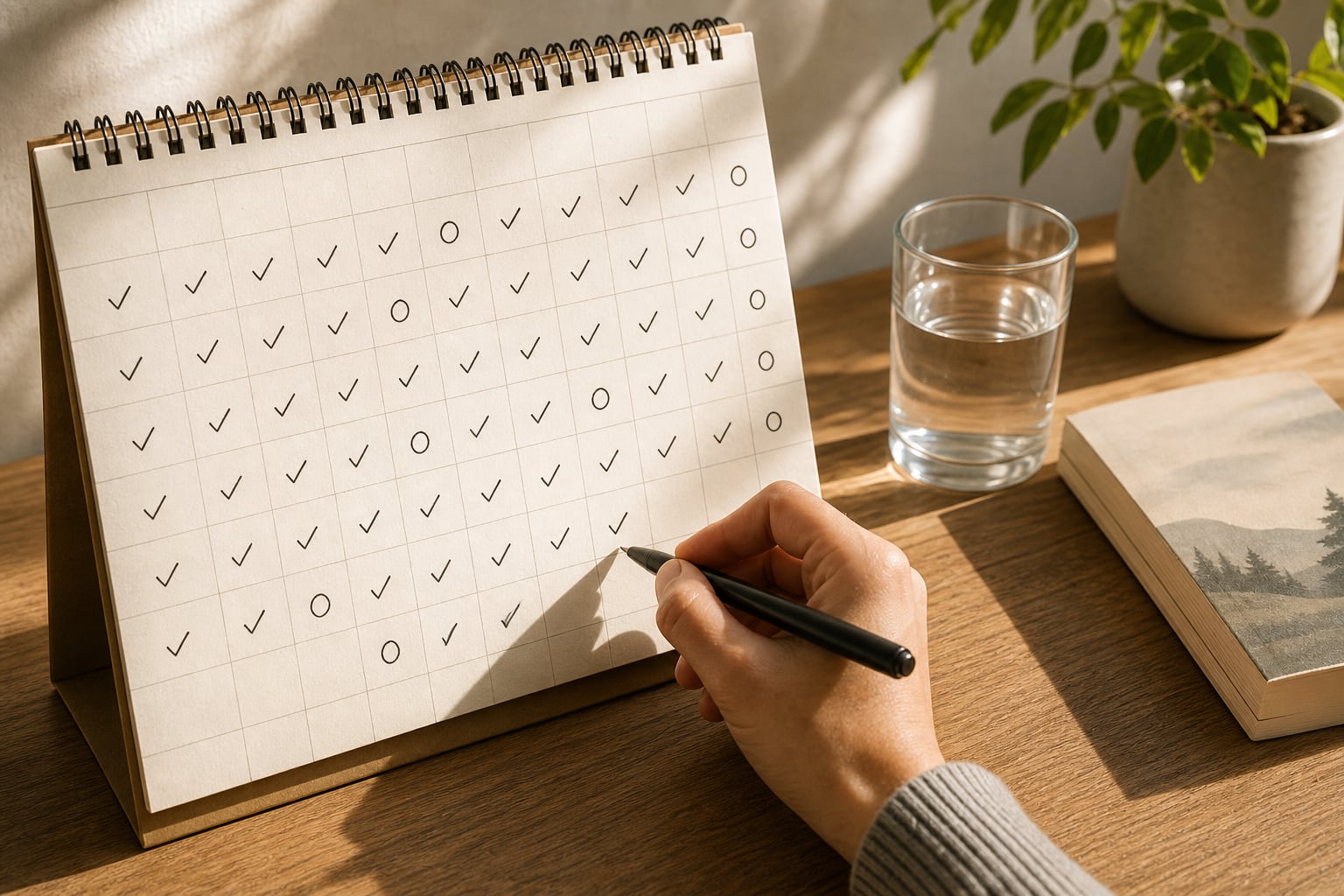
Shrink the action until it is almost too easy to skip. One page, not one chapter. Two minutes of cold water, not ten. A single line in the journal. The point of a small start is not the result today; it is protecting the streak while the behavior takes root across those 66 days. Track it somewhere you will see it, because a visible chain is hard to break. When you miss, and you will, restart the next morning without the guilt tax. To invest in yourself is a decision you renew daily, not a badge you earn once. The compound effect only pays the people who stay in the market.
Choose the first practice by the bottleneck:
- Tired all day: start with wake time and morning light.
- Avoiding discomfort: start with a short cold finish or one hard task first.
- Mentally cluttered: start with journaling.
- Distracted and shallow: start with reading.
- Inconsistent everywhere: start with the smallest trackable action and never miss twice.
FAQ
Does investing in yourself have to cost money?
No. The highest-return starting points here are free: morning light, a stable wake time, a few lines of journaling, and reading a book you already own.
What should you invest in first?
Start with the constraint that is costing you the most. Low energy points to sleep and light. Low clarity points to journaling. Low focus points to reading.
How do you know it is working?
Look for less negotiation. The practice starts as effort, then becomes evidence, then becomes part of who you believe you are.
Being THE ONE
THE ONE invests daily. Not in bursts. Not when inspired.
THE ONE makes the deposit before the resistance wakes up. Skips the applause. Keeps the streak.
THE ONE knows the 66 days are the price, not the punishment. Pays it without complaint.
You are not built by the year you plan. You are built by the morning you show up. Not by the goal you set. By the system you repeat. Not by the intensity of one week. By the boredom of one thousand quiet mornings.
Be the one who does the small thing again today. Then tomorrow. Then long enough for it to compound into a life.
Sources
- Lally, P., van Jaarsveld, C. H. M., Potts, H. W. W., & Wardle, J. (2010). "How are habits formed: Modelling habit formation in the real world." European Journal of Social Psychology, 40(6), 998–1009. https://onlinelibrary.wiley.com/doi/10.1002/ejsp.674
- Clear, J. (2018). Atomic Habits: Tiny Changes, Remarkable Results, p. 27. Avery. https://jamesclear.com/atomic-habits
- Fogg, B. J. (2020). Tiny Habits: The Small Changes That Change Everything. Houghton Mifflin Harcourt. https://www.behaviormodel.org
Ready to put this into practice? Track your daily streak and watch the small deposits compound.