Daily practice
One Push Up
One push up is enough. The first rep breaks inertia. The rest is momentum. Research on minimum viable habits, tiny habits methodology, and push-up capacity as a health marker shows the smallest possible action is the one that actually changes anything. Start with one.

In this article
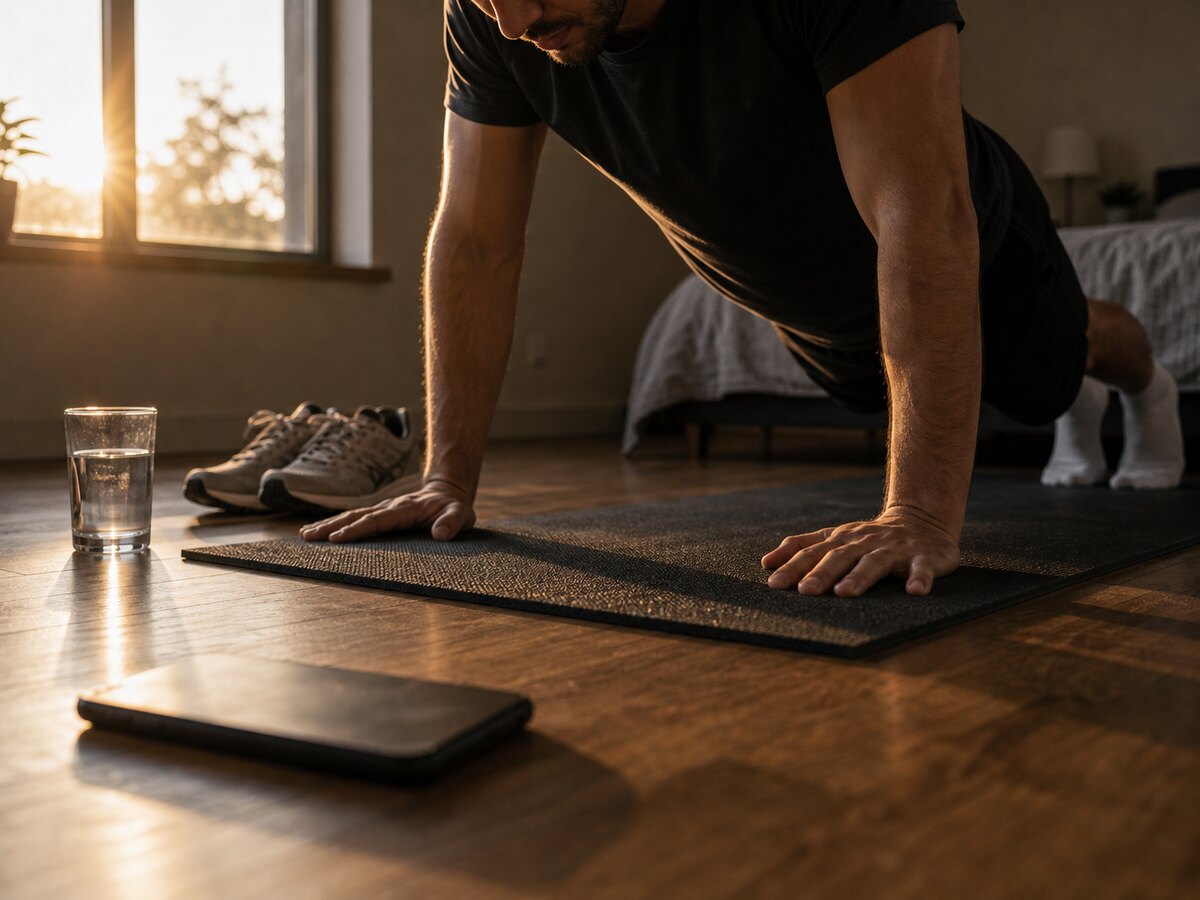
One push up is the minimum viable action for breaking inertia. The first rep is the whole battle. The rest is momentum. Research on BJ Fogg's tiny habits methodology, push-up capacity as a cardiovascular marker, and exercise effects on depression shows the smallest possible action changes more than any big plan. Start with one.
You do not need to do fifty. You need to do one.
The first rep is breaking inertia. Everything after that is just momentum. This is not really about reps. It is about everything. Every change you have been putting off, every habit you have been meaning to start, every conversation you have been avoiding. The problem is not that the thing is hard. The problem is that you have not started.
Why does one push up actually work where fifty fails?
One push up works where fifty fails because fifty requires conditions you cannot reliably produce. Motivation. Energy. Time. Equipment. One requires almost nothing. BJ Fogg's Tiny Habits (2019) documented that behaviors small enough to feel trivial consistently outperform ambitious daily commitments.
The mechanism is motivation-independence. The more a behavior depends on motivation, the less reliably it happens. A near-zero-effort action happens on every day. An ambitious plan only happens on high-motivation days, which is maybe 30 percent of days.
The math is severe. One rep on 365 days produces 365 reps, plus the identity of someone who does this daily, plus the days when "just one" turned into twenty. The small approach wins on output and on identity construction simultaneously. (Related: Identity-Based Discipline.)
What does the research on push up capacity actually show?
Push up capacity functions as one of the most reliable cardiovascular health markers available. Yang and colleagues' 2019 study in JAMA Network Open found that men who could do 40+ repetitions had a 96 percent lower risk of cardiovascular disease events compared to those who could do fewer than 10.
The study followed 1,104 male firefighters over ten years. The test outperformed treadmill-based aerobic capacity as a cardiovascular predictor. The test is free, takes one minute, and predicts decade health more reliably than most expensive screenings.
The practical implication is that this number is not just a strength metric. It is a health screening. One rep today is the first data point. Building to 40+ is among the highest-leverage health interventions available. (Related: Build the Temple.)
How does physical activity directly affect mental health?
Physical activity directly affects mental health in ways that rival professional treatment. Singh and colleagues' 2023 meta-analysis in the British Journal of Sports Medicine, "Effectiveness of Physical Activity Interventions for Improving Depression, Anxiety and Distress: An Overview of Systematic Reviews," synthesized 97 review articles covering 1,039 trials and found that physical activity produced benefits comparable to psychotherapy and pharmacotherapy for depression and anxiety.
The mechanism includes endorphin release, reduced inflammation, improved sleep architecture, and increased self-efficacy. The effect size was substantial. The researchers concluded that exercise should be a first-line treatment for mild to moderate depression, not an optional adjunct. The research has been available for years. Most clinicians still under-prescribe it because it requires patient effort, unlike pills.
One rep per day is not enough to produce the full effect. But that one rep starts the chain that leads to sustainable daily movement, which produces the full effect. Breaking the zero-to-something barrier is the prerequisite. Everything after is additional compounding on top of that baseline. (Related: Morning Routine for Burnout Recovery.)
What is the one push up protocol in practice?
The one push up protocol in practice is simple. Pick the thing you have been avoiding. Shrink it to the smallest possible version. Something so easy that no valid excuse can generate. Then do that minimum every single day. No exceptions. No negotiation. The deal is: minimum is mandatory, more is optional.
Most days you will do more than the minimum. That is the secret. One rep turns into ten. One page turns into a chapter. One minute of meditation turns into fifteen. Once momentum takes over, output expands naturally. On the days you only do the minimum, you still win. You maintained the streak. You kept the pattern alive. You reinforced the identity.
The days you least feel like doing it are the most important days to do it. Anyone can show up when they feel great. Showing up when you feel terrible, even for one rep, is what separates the person who changes from the person who stays the same. Exhausted. Sick. Mentally destroyed. Get on the floor. Do one. It makes no physical difference on that day, but it makes a structural one. You told your nervous system that this person does not quit. (Related: Consistency Is Key.)
What happens when you run the protocol for months?
When you run the protocol for months, the compounding becomes visible. The first thirty days break inertia. The next sixty days the pattern becomes automatic. After 90 days, the behavior runs without willpower and the identity has shifted from "trying" to "doing."
A person who does one to ten reps daily for a year produces more total reps than a person who does fifty two or three times a week, because the consistent person almost never misses and the ambitious person frequently does. The consistent person also builds a self-concept that sustains the behavior across decades.
Three years in, you have a stack of five to ten small daily habits, each installed through the same protocol. The compound effect has produced a different person. None of it required superhuman willpower. All of it required the willingness to start with one. (Related: Atomic Habits.)
Being THE ONE
THE ONE starts with one.
Not fifty. Not twenty. One. Knows the first rep is the battle and the rest is momentum. Refuses to let the ego's demand for grand gestures delay the small action that actually moves.
THE ONE treats minimum as mandatory, more as optional. Does the minimum every single day. No exceptions. No negotiation. Lets momentum handle the expansion on good days and accepts the minimum as the whole win on hard ones.
THE ONE understands that the days you feel worst are the days the practice matters most. Shows up through exhaustion. Through illness. Through every signal the body sends to skip. Does the minimum anyway, because the commitment is identity and identity does not take days off.
Stop waiting for motivation.
Stop waiting for the perfect plan.
Stop waiting for Monday.
Get on the floor. Do one push up. Let momentum handle the rest.
That is how everything changes. Not in a single dramatic moment. In the smallest possible action repeated until it becomes who you are.
One push up. Start there.
Start now.
Be the one who started small and outlasted everyone with the big plans.
Sources
- Yang, J., Christophi, C. A., Farioli, A., et al. (2019). "Association Between Push-up Exercise Capacity and Future Cardiovascular Disease Events in Active Adult Men." JAMA Network Open, 2(2), e188341. https://jamanetwork.com/journals/jamanetworkopen/fullarticle/2726980
- Singh, B., Olds, T., Curtis, R., et al. (2023). "Effectiveness of Physical Activity Interventions for Improving Depression, Anxiety and Distress: An Overview of Systematic Reviews." British Journal of Sports Medicine, 57(18), 1203-1209. https://pubmed.ncbi.nlm.nih.gov/36796860/
- Fogg, B. J. (2019). Tiny Habits: The Small Changes That Change Everything. Houghton Mifflin Harcourt. On minimum viable behavior change. https://tinyhabits.com/
- Clear, J. (2018). Atomic Habits: Tiny Changes, Remarkable Results. Avery. On the two-minute rule and identity-based habits. https://jamesclear.com/atomic-habits
Make room for the practice. Plan your weekly practice time and see how the sessions add up.