Daily practice
The 10,000-Hour Rule and the Quiet Practice Behind Skill
What deliberate practice can teach us, why 10,000 hours is not a guarantee, and how to build a small practice with feedback and a clear next step.

In this article
English edition: 16 October 2026. This guide originated in German on 25 April 2026. Both editions were revised together to correct the research claims and practice-hour calculations.
A practice can matter before anyone notices it. A musician repeats a difficult passage, a learner tries a sentence aloud, and a writer revises an unclear paragraph. None of those attempts needs an audience. What makes the time useful is the task and what the learner does with the result.
The familiar 10,000-hour rule can make that patient work sound like a countdown to guaranteed expertise. It is not. Keep the valuable idea of sustained effort; leave behind the promise that a particular total makes everyone a master.
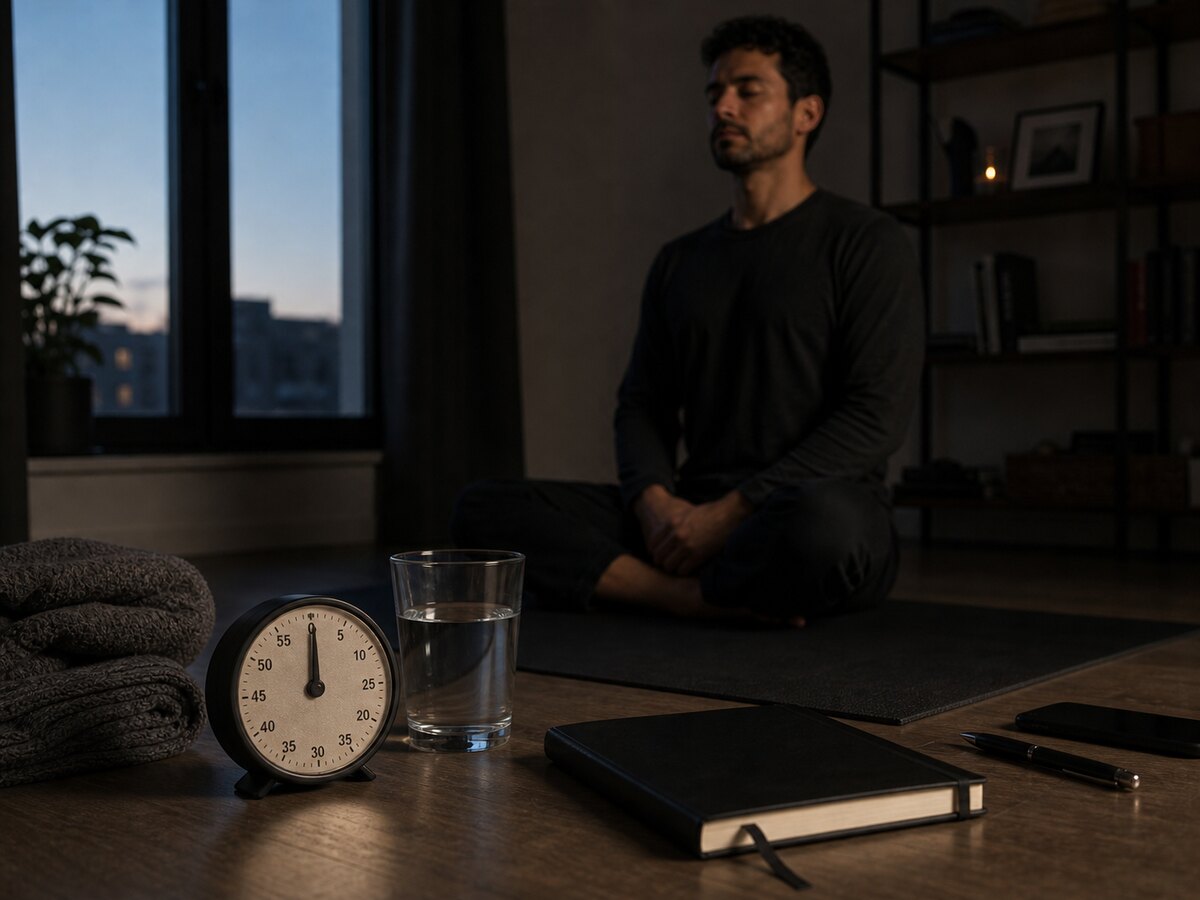
An illustration of a quiet routine. Stillness can create room to begin, but it is different from targeted practice of a particular skill.
The 10,000-hour rule is not a promise that a fixed amount of time produces mastery. Useful practice has a particular task, a way to review the result, and a next attempt shaped by what you learn. Build a schedule that fits your life; judge the work by more than its duration.
What does the 10,000-hour rule actually mean?
The number became widely known through Malcolm Gladwell’s Outliers. It refers to a pattern discussed in research on expert performance, not an entry requirement or a universal finishing line. A practice log cannot tell you what someone will achieve simply by reaching 10,000 hours.
In this guide, “quiet practice” means making room to work on a skill without needing immediate public recognition. It does not mean that solitude causes learning, that you must hide your work, or that learning without feedback is better. A lesson with a teacher and a rehearsal with others can be valuable practice too.
Try defining the work before defining the identity: “I will practice changing between these two guitar chords” gives you something to inspect. “I will become exceptional” gives you no task for this afternoon. Related reading: Mastery Takes Time.
What did Ericsson’s deliberate-practice research show?
Anders Ericsson, Ralf Krampe, and Clemens Tesch-Römer’s 1993 paper examined expert performance and practice histories, including those of student violinists. It helped establish the importance of sustained, purposeful training. The reported histories were retrospective estimates; they did not establish a universal number of hours that guarantees expertise.
The interpretation remains debated. A 2019 violinist study by Macnamara and Maitra found a substantial association with practice but did not reproduce the original pattern across every skill group. The authors wrote, “We did not replicate the core finding” (2019, Abstract). That is a reason to distinguish practice as a useful activity from the stronger claim that hours alone explain differences between people.
For your own work, use three practical questions: what am I trying to improve, how will I see the result, and what can I change on the next attempt? These are our editorial learning prompts, not a validated formula or a promise of elite performance. The One Percent offers another way to think about small repeated actions.
How is quiet practice different from staying busy?
Activity and improvement are different things. Playing familiar songs may be enjoyable and worthwhile. Working on one transition that repeatedly interrupts your playing serves a different purpose. You do not need to dismiss enjoyment to make that distinction.
Name the task, choose an appropriate challenge, and decide how to review it. For example, record a short passage, listen for the transition you selected, and compare two attempts. If you cannot tell what you are checking, narrow the task before adding more time.
Feedback can come from a teacher, an appropriate standard, a worked solution, or a recording. Self-review has blind spots, so seek another perspective when you are stuck. A difficult session is not automatically a good session; exhaustion and pain are not evidence that you learned. See The Cost of Distraction.
How can you make room for practice in everyday life?
Choose a window that fits your actual obligations and energy. A quiet morning can suit one person; a lunch break or an afternoon lesson can suit another. Do not cut sleep to copy someone else’s schedule. Ten focused minutes may be a sensible start; a longer block is an option to test, not a requirement.
Prepare what the task needs. Put the instrument, exercise, or notebook where you will use it. If notifications interrupt you, silence them for the agreed window. Finish by writing one observation and the next task, so the next session does not begin with another planning meeting.
Be careful with the arithmetic. One hour every day for ten years is about 3,650 hours, not 36,500. Two daily hours would be about 7,300, and three about 10,950, assuming 365 days a year and no missed days. These totals illustrate time only. They are not recommended workloads and do not measure practice quality. Own Your Morning can help you plan a window that leaves room for the rest of life.
How can practice become part of your identity?
A record of attempts gives you something more concrete than an all-or-nothing label. Instead of “I am disciplined” or “I am hopeless,” you can see what you planned, what you tried, and what got in the way. Treat the record as information, not a verdict on your worth.
Try a weekly note with four fields: the skill, the task, feedback from an attempt, and a possible adjustment. If you missed the session, note the reason without inventing a fixed deadline for when your identity should change. A period of 90 days can organize an experiment; it is not a biological guarantee.
Our fictional learner Lena wants to hold a short conversation in Italian. She practices one café exchange twice in a week, records one attempt, and asks a teacher about an unclear phrase. In the following week, she changes that phrase and tries again. Her record shows a learning process, not a claim that two sessions made her fluent. See The 90-Day Identity Shift.
Being THE ONE
Choose work that matters enough to return to. Give it a task small enough to begin and clear enough to review. You can care about recognition without making applause the condition for practicing.
For the next session, write one sentence for each of these:
- The skill I want to practice.
- The specific task I will try.
- The feedback I can use.
- A time and stopping point that fit my capacity.
- One question to carry into the next attempt.
If the plan does not fit, change the plan. A smaller task, a different time, or a request for guidance can be a useful next step. The point is to make learning possible, not to defend a streak at any cost.
Frequently asked questions
Does the 10,000-hour rule help without external rewards?
The 10,000-hour rule can remind you that learning takes sustained work, but a useful task matters more than a distant total. Choose one you have a reason to care about and keep a small record of what you learned. Notice progress where you can actually observe it. If the work has stopped making sense, reconsider the goal, difficulty, or support available. You do not owe an old plan endless hours.
What role do mentors play?
A suitable teacher can help choose tasks and notice errors you miss. If that is unavailable, use a worked example, recording, or another reliable way to inspect an attempt. Ask for help when the limits of self-review become clear. This is especially relevant where errors can cause harm.
How do I combine quiet practice with visibility?
Sharing can bring feedback, collaborators, or opportunities. Decide what you want from it and protect enough time to do the work itself. There is no research-backed 90/10 split prescribed here. A private draft, a lesson, and a public performance can play different roles.
Sources
- Ericsson, K. A., Krampe, R. T., & Tesch-Römer, C. (1993). The Role of Deliberate Practice in the Acquisition of Expert Performance. Psychological Review, 100(3), 363–406. Original research; not a universal 10,000-hour guarantee.
- Macnamara, B. N., & Maitra, M. (2019). The role of deliberate practice in expert performance: revisiting Ericsson, Krampe & Tesch-Römer (1993). Royal Society Open Science, 6, 190327. Replication and discussion of the limits of practice-hour explanations.
- Newport, Cal. (2012). So Good They Can’t Ignore You. Author’s books. A popular account of skill development, not a controlled trial.
- Newport, Cal. (2016). Deep Work. Author’s books. A practical argument for focused work; no universal block length is prescribed here.
- Gladwell, Malcolm. (2008). Outliers. Little, Brown and Company. Popularized the 10,000-hour idea; distinguish the account from the underlying research.
- Clear, James. (2018). Atomic Habits. Avery. German edition: Die 1 Prozent Methode (2020), Goldmann. A framework for thinking about habits and identity, not proof of a fixed identity-change timetable.
Ready to plan your next session? Explore the daily-systems guides or make a short morning plan.