Daily practice
The Stillness Practice
The stillness practice is the trained ability to sit with your own mind, long enough for the noise to settle and what remains to show itself. Five minutes a day rewires attention, reduces anxiety, and builds the gap between stimulus and response where your power actually lives. The practice is boring, uncomfortable, and cheaper than any therapy that would produce similar results.

In this article
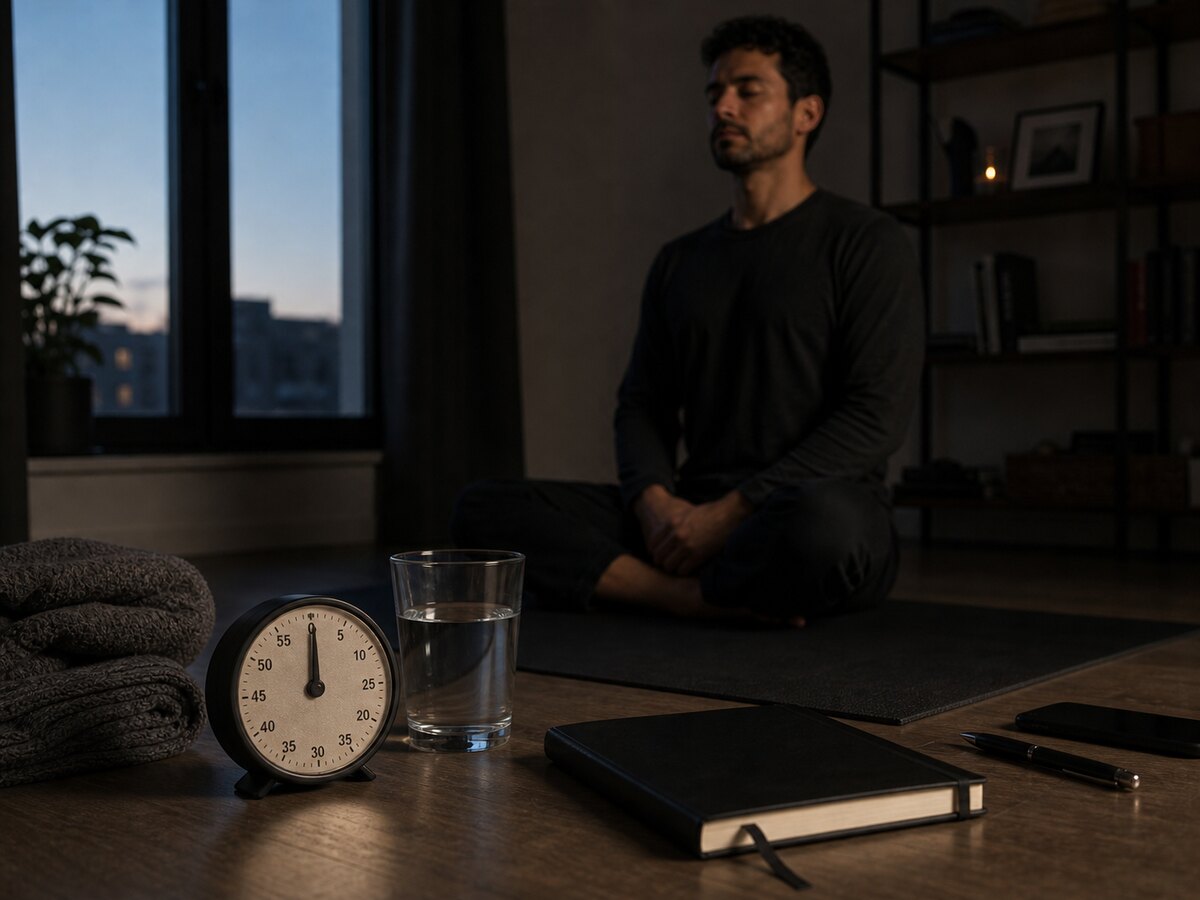
The stillness practice is the trained ability to sit with your own mind, long enough for the noise to settle and what remains to show itself. Five minutes a day rewires attention, reduces anxiety, and builds the gap between stimulus and response where your power actually lives. The practice is boring, uncomfortable, and cheaper than any therapy that would produce similar results.
Five minutes of silence every day will teach you more about yourself than five years of noise.
Most people do not believe that until they try it. The first 45 seconds, the mind panics. The urge to reach for a phone, a podcast, anything, is enormous. That reaction is the whole reason the stillness practice is necessary.
What is the stillness practice and why is it hard?
The stillness practice is sitting with your own mind for a defined period, without input, without distraction, letting the noise settle so that awareness itself becomes observable. It is hard because modern life trains the brain to expect constant stimulation. When you take the stimulation away, even for 60 seconds, the mind generates its own noise to fill the void.
This is why people say "I cannot meditate, my mind is too busy." The mind is always busy. You have never sat still long enough to notice. The noise that shows up in the first few minutes was already running in the background of your normal day. Sitting down just removes the cover that was hiding it.
The discomfort of the first attempts is the diagnostic. If sitting alone with your own thoughts for five minutes is genuinely uncomfortable, that is useful information. The person who has already learned this skill is in much better shape than the one who has not when life eventually demands it. (Related: Breathe Before You React.)
What is the 5-minute stillness protocol?
The protocol is unglamorous and it works. Sit down. Set a timer for five minutes. Close your eyes. Breathe normally. Do nothing. Your mind will race. Let it. Do not try to stop the thoughts. Notice them the way you would notice clouds passing. They come. They go. You stay.
The goal is not an empty mind. The goal is observation. You are building the muscle of awareness: the ability to watch your own thoughts without being controlled by them. This is the most useful skill you will ever develop, because it creates a gap between stimulus and response. Someone says something triggering. Instead of reacting instantly, there is a pause. A breath. A choice. That pause is where agency lives.
Start with five minutes. It sounds small. It is not. Five genuine minutes, where you are not planning, rehearsing, or making lists, is harder than most workouts. Your ego will resist because the ego needs activity to survive. Doing nothing threatens the part of you that finds identity in doing. That resistance is information, not a reason to stop. (Related: Make Discomfort a Practice.)
What does the research say about daily meditation practice?
The research on meditation practice is extensive and consistent. Sara Lazar's 2011 study at Massachusetts General Hospital / Harvard, published in Psychiatry Research: Neuroimaging, found that 8 weeks of mindfulness-based stress reduction produced measurable increases in gray matter density in the hippocampus (involved in learning and memory) and decreases in the amygdala (involved in stress response). The brain physically changes from sustained practice.
Goyal and colleagues' 2014 meta-analysis in JAMA Internal Medicine, covering 47 clinical trials and over 3,500 participants, found that mindfulness meditation programs produced moderate reductions in anxiety (effect size 0.38) and depression (0.30). The effect sizes are not dramatic. They are, in clinical terms, on par with antidepressants for mild-to-moderate cases, without the side effects.
The practical implication is that silence meditation is not a fringe practice. It is one of the cheapest, best-studied, most reliable interventions for psychological well-being available. The cost is five minutes a day. Benefits span anxiety, depression, attention, emotional regulation, and pain tolerance. The only reason more people do not do it is that the early weeks are boring. (Related: Guard Your Peace.)
What will I actually find in the silence?
In the silence, three things usually show up. First, how loud the inner critic is. The running commentary of self-judgment that blends into the background of a noisy day becomes deafening when nothing else is happening. Hearing it clearly is the first step to defusing it.
Second, emotions that were stored and never processed. Grief. Anger. Sadness. Frustration. Things the daily pace buried. Sitting down gives these the room to surface, which feels uncomfortable until you realize the stored version was costing more than the surfaced version. The practice functions as informal emotional maintenance, which is why it tends to reduce the big emotional events over time.
Third, clarity. The answer to a problem you have been overthinking for weeks simply appears, often in the quietest part of the session. Not because you were working on it. Because you finally stopped working on it long enough for the answer to arrive. Your subconscious mind solves problems in the background continuously. You never hear its answers when you never stop talking. (Related: The Power of Silence.)
How do I build a sustainable daily mindfulness practice?
Build a sustainable mindfulness practice by attaching it to an existing cue. After pouring morning coffee, sit for five minutes. After brushing teeth, sit for three. The trigger matters more than the duration. A trigger-less five minutes relies on memory and motivation, both of which fail. A trigger-attached two minutes runs on autopilot.
Do not add length until the base is automatic. Most people make the mistake of trying to sit for 30 minutes from day one. They last three days, burn out, and conclude they cannot meditate. They can. They just tried to build the cathedral before the foundation was dry. Start with what is boring small. Let the habit form. Add length only when the current length feels automatic.
The consistency matters more than the length. Twenty sessions of five minutes across a month produces measurable change. Three sessions of thirty minutes does not. The brain changes through repetition across weeks, which is why the unglamorous daily minimum outperforms the occasional heroic effort. This is true of every trainable skill, and the stillness practice is trainable exactly the same way. (Related: How to Stay Disciplined When You Don't Feel Like It.)

Being THE ONE
THE ONE sits in silence.
Daily. Five minutes. Same time. Same place. Not because five minutes is heroic. Because five minutes is survivable, and survivable is what compounds.
THE ONE does not avoid the silence. Uses it. Lets the noise settle, lets the hidden material surface, lets the clarity arrive in its own time.
THE ONE knows the practice is the cheapest and best-studied intervention for attention, mood, and clarity available to a human nervous system.
Sit down.
Shut up.
Listen.
What you find in the silence is you, without the noise that has been covering you for years.
Meet yourself.
Be the one who stayed still long enough for the noise to settle.
Sources
- Hölzel, B. K., Carmody, J., Vangel, M., Congleton, C., Yerramsetti, S. M., Gard, T., & Lazar, S. W. (2011). "Mindfulness practice leads to increases in regional brain gray matter density." Psychiatry Research: Neuroimaging, 191(1), 36-43. MGH/Harvard study on meditation-induced gray matter changes. https://pmc.ncbi.nlm.nih.gov/articles/PMC3004979/
- Goyal, M., Singh, S., Sibinga, E. M. S., et al. (2014). "Meditation programs for psychological stress and well-being: A systematic review and meta-analysis." JAMA Internal Medicine, 174(3), 357-368. 47-trial meta-analysis. https://jamanetwork.com/journals/jamainternalmedicine/fullarticle/1809754
- Kabat-Zinn, J. (1990). Full Catastrophe Living: Using the Wisdom of Your Body and Mind to Face Stress, Pain, and Illness. Delta. Foundational MBSR text. https://www.penguinrandomhouse.com/books/332032/full-catastrophe-living-revised-edition-by-jon-kabat-zinn-phd/
- Holiday, R. (2019). Stillness Is the Key. Portfolio. Modern synthesis of Stoic and Eastern traditions on stillness as practice. https://www.penguinrandomhouse.com/books/559308/stillness-is-the-key-by-ryan-holiday/
Ready to try it? Begin a short meditation practice with simple steps and an optional timer.