Identity
What Are You Building
What are you building is the question that separates busy from meaningful. At the end of your life, nobody asks how many hours you worked. They look at what you built. Research on long-horizon work, deliberate practice, and goal-setting theory shows most people are busy without building.

In this article
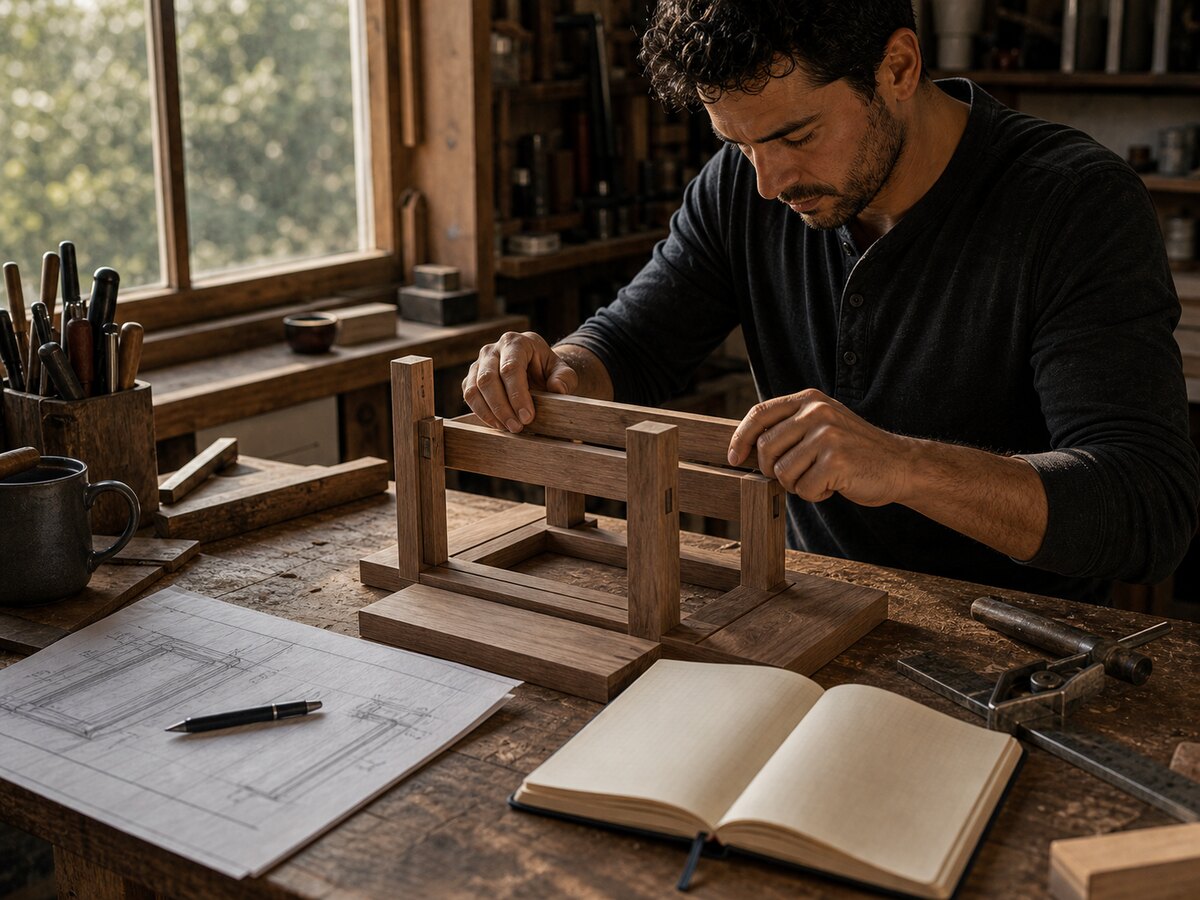
What are you building is the question that separates busy from meaningful. At the end of your life, nobody will ask how many hours you worked. They will look at what you built. Research on long-horizon work, deliberate practice, and goal-setting theory shows most people are busy without building. Activity is not architecture. Motion is not progress. Ask the question now.
At the end of your life nobody will ask how many hours you worked.
They will not ask about your title. They will not ask how many emails you answered. They will not care how full your calendar was. They will look at what you built. A family that knows you. A business that serves people. A body that carried you well. Relationships that were real. A body of work that meant something.
What does long-horizon research say about building versus busy?
Long-horizon research, synthesized in Hal Hershfield's work at UCLA on future-self continuity and Cal Newport's Deep Work (2016), documents that people who orient their daily actions toward decade-long outcomes produce fundamentally different lives than people oriented toward day-level urgency. The difference is not talent or resources. It is time horizon.
Hershfield's 2011 paper in the Annals of the New York Academy of Sciences, "Future Self-Continuity," found that people who felt connected to their future selves made better decisions across saving, health, and career domains. The reverse also holds. People disconnected from the future self defaulted to short-term optimization that looks productive in the week and compounds into wasted years.
The practical implication is that building requires time horizon that busy does not. Busy optimizes for today's inbox. Building optimizes for next decade's body of work. The orientations are incompatible. Choosing one displaces the other. Most people never deliberately choose, so busy wins by default. The day fills with urgencies. The year passes. Nothing lasting was built. (Related: Legacy Is Daily.)
Why is busy the enemy of building?
Busy is the enemy of building because busy is someone else's agenda running through your calendar. Responding to everything. Available to everyone. Putting out fires all day and calling it work. At the end of each year, busy people look back and realize that despite all the effort, nothing lasting was created. Treading water and calling it swimming.
Research on decision fatigue and deep work consistently shows that the interruptions driving most people's days destroy the capacity for the sustained focus building requires. Newport's Deep Work documented that the skills that produce real output, the ones that compound into something worth having, require 2-4 hour blocks of uninterrupted focus. Busy people almost never have these blocks. The calendar ate them.
The shift comes from asking a brutal question: if you keep doing what you are doing for the next five years, what will you have? Not how will you feel. What will exist in the world because of your effort? For most people, the honest answer is nothing. More emails answered. More meetings attended. More favors done for people who will not remember your name. But nothing built. The answer hurts. It is supposed to. (Related: The Cost of Distraction.)
What does the research say about what actually takes years to build?
Research on expert performance, particularly K. Anders Ericsson's deliberate practice studies published across decades, documents that meaningful capabilities require thousands of hours over years of sustained effort. Ericsson's 1993 paper in Psychological Review established the 10,000-hour framework later popularized by Malcolm Gladwell. The exact number varies, but the principle holds: real mastery, real bodies of work, real builds take years.
A business takes years. A body takes years. A skill takes years. A marriage takes decades. Most people looking for quick results abandon the thing precisely when the compounding was about to start. The first three years of anything serious feel like nothing is happening. Years 4-7 produce visible acceleration. Years 8+ produce compounding that looks impossible from outside. The people who stayed in produce the outcomes. The people who quit before year three produce stories about why it did not work.
The implication for "what are you building" is that the answer has to tolerate years of invisible progress. Edwin Locke and Gary Latham's goal-setting research, published across hundreds of studies, consistently found that specific, difficult, long-horizon goals produced better outcomes than vague or short-term ones. Build something specific. Accept that it will take years. Trust the compounding. (Related: Mastery Takes Time.)
What is worth building versus worth experiencing?
Not everything worth doing is worth building. Some things are meant to be experienced and released. A great meal. A vacation. A night with friends. Not everything needs to be a project. But some things do. Knowing the difference matters.
The practical filter: if something will matter in ten years, it is worth building. If it will not matter in ten months, it is not. Your health will matter in ten years. Build it. Your closest relationships will matter in ten years. Build them. Your financial foundation will matter in ten years. Build it. Your skills, knowledge, capacity to think clearly. These will matter in ten years. Build them.
Your social media following probably will not matter in ten years. The latest controversy will not matter in ten months. The argument you had in traffic will not matter in ten minutes. Stop building things that do not last. Keep a short list on your desk. Three things you are building. Every day check actions against the list. Did you invest in any of the three today? If no, the day was wasted no matter how busy. (Related: What You Tolerate You Encourage.)
How does the builder's mindset actually work?
The builder's mindset thinks in years, not days. Says no to good opportunities so it can say yes to great ones. Does not get distracted by what other people are building because it is too focused on its own work. Accepts that the early stages of anything look like failure. The foundation is not impressive. Nobody applauds for pouring concrete. But without it, nothing stands.
Research on grit by Angela Duckworth, published in the 2007 Journal of Personality and Social Psychology, documented that sustained passion and perseverance toward long-term goals predicted achievement more reliably than IQ, talent, or family advantage. The builder's mindset is grit applied. Not every day. Every year.
The question is direct. What are you building? Not what are you doing. Not what are you planning. What, actually, right now, in your daily actions, are you building? If you do not have a clear answer, that is the problem. Not your schedule. Not your resources. Not your circumstances. You have not decided what to build. Once you decide, the days organize themselves around the decision. Pick the thing. Commit to it for years. Show up every day and lay one more brick. At the end of your life, the only question that matters is what you built. Make sure you have an answer. (Related: Trust the Process.)
Being THE ONE
THE ONE knows what they are building.
Can name it specifically. Can describe the ten-year trajectory. Can point to today's action that moves the trajectory forward. Does not confuse busy with building.
THE ONE tolerates the first three years of invisible progress. Accepts that foundations are boring. Lays concrete that nobody applauds for. Trusts that the compounding will arrive in year four and accelerate from there.
THE ONE filters ruthlessly. If it will not matter in ten years, it does not get the attention today. The short list sits on the desk. Actions get checked against the list daily. Days that serve nothing on the list are wasted, regardless of how full they felt.
At the end of your life, the only question that matters is what you built.
Ask it now.
What are you building? Not what are you doing. What are you building?
If you do not have an answer, the problem is not time. The problem is that the decision has not been made.
Make the decision.
Pick the thing. Commit to it for years. Show up every day and lay one more brick.
Be the one who built something lasting while everyone else was busy building nothing.
Sources
- Newport, C. (2016). Deep Work: Rules for Focused Success in a Distracted World. Grand Central. On long-horizon focus vs distraction. https://www.calnewport.com/books/deep-work/
- Hershfield, H. E. (2011). "Future Self-Continuity: How Conceptions of the Future Self Transform Intertemporal Choice." Annals of the New York Academy of Sciences, 1235, 30-43. On time horizon and decisions. https://doi.org/10.1111/j.1749-6632.2011.06201.x
- Ericsson, K. A., Krampe, R. T., & Tesch-Römer, C. (1993). "The Role of Deliberate Practice in the Acquisition of Expert Performance." Psychological Review, 100(3), 363-406. On sustained effort and mastery. https://psycnet.apa.org/record/1993-40718-001
- Duckworth, A. L., Peterson, C., Matthews, M. D., & Kelly, D. R. (2007). "Grit: Perseverance and Passion for Long-Term Goals." Journal of Personality and Social Psychology, 92(6), 1087-1101. On grit and achievement. https://psycnet.apa.org/record/2007-07951-004
Ready to put this into practice? Check your identity alignment and see where you actually stand.