Relationships
Fathers And Sons
Children do not listen to what parents say. They watch what parents do. Research on social learning theory, attachment, and intergenerational transmission shows modeling outperforms instruction every time. The best thing a father can do for his kids is become the person he wants them to become.

In this article
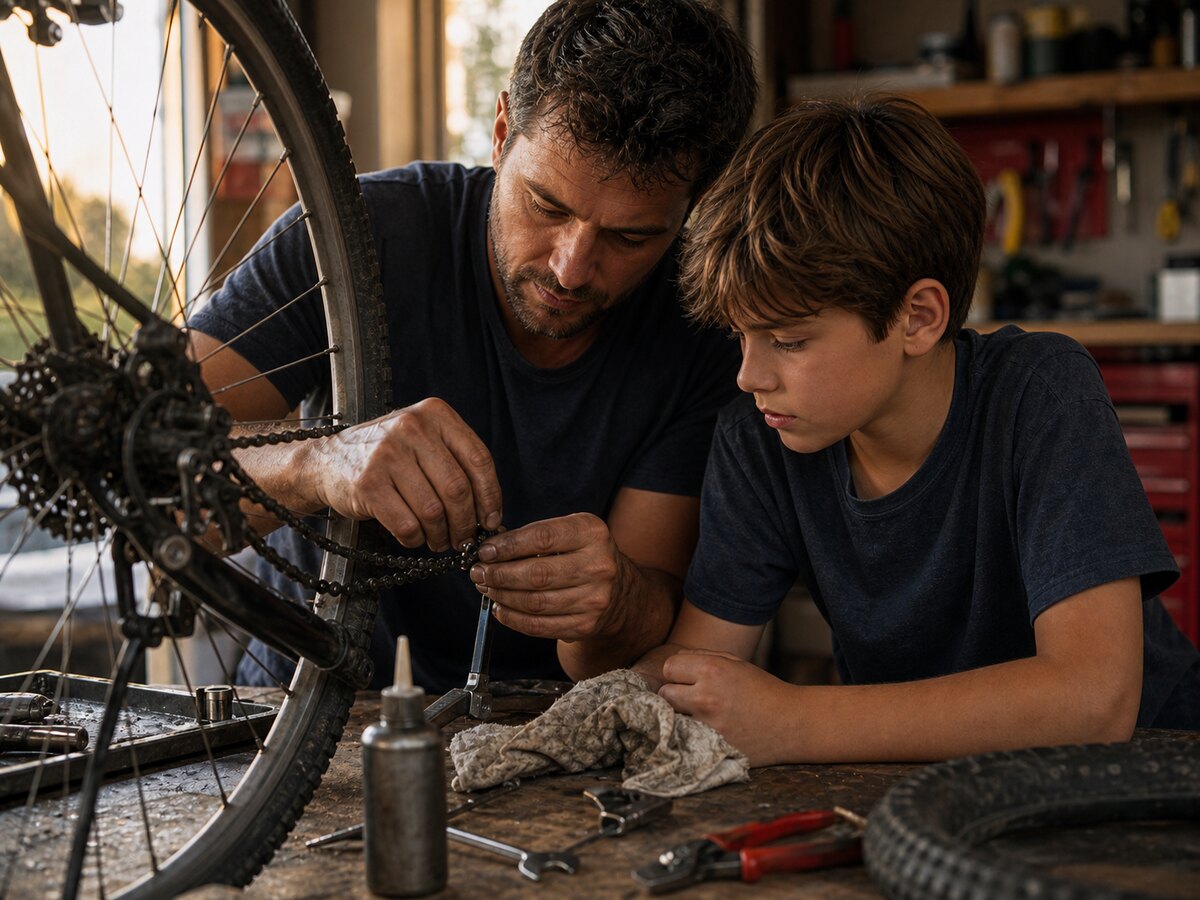
Fathers and sons is the practice of intentional modeling over instruction. Children watch what fathers do, not what fathers say. Research on social learning theory, attachment styles, and intergenerational transmission of behavior shows modeling transfers reliably while verbal instruction transfers poorly. The best thing a father can do for his kids is become the person he wants them to become.
Children do not listen to what you say. They watch what you do.
You can tell your son to be disciplined while sitting on the couch every evening. You can tell your daughter to respect herself while letting people walk all over you. You can give the speech about hard work while avoiding everything difficult in your own life. They will not hear a word of it. But they will absorb every action.
What does social learning theory say about modeling?
Social learning theory, developed by Albert Bandura and formalized in his 1977 book Social Learning Theory, documented that children acquire behavior primarily through observing and imitating models, especially parents, rather than through direct instruction or reinforcement. Bandura's Bobo doll experiments in 1961 demonstrated that children exposed to adult aggressive behavior reproduced that behavior themselves, without any verbal instruction.
The implication for fathers and sons modeling parenting is direct. The lecture you give is information the child processes consciously and forgets within hours. The behavior you model is information the child absorbs subconsciously and carries forward for decades. The ratio of impact is not close. Modeling wins by an order of magnitude in almost every developmental domain studied.
This is why children of contradictory parents often repeat the parent's behavior rather than the parent's instruction. The father who preaches emotional openness but never demonstrates it raises a son who cannot express emotion, regardless of how many times the speech was given. The modeling trumps the instruction every time. (Related: Words Without Action.)
How does intergenerational transmission actually work?
Intergenerational transmission works through repeated exposure during developmental windows. What you saw your father do, in the moments he was not performing parenting, became the template for what a man does. The emotional regulation, the response to conflict, the treatment of women, the relationship with work, the handling of failure, all transmitted through observation, almost none of it through verbal lesson.
The Harvard Study of Adult Development, running since 1938 and now entering its ninth decade, documented that relationship patterns in adulthood correlated strongly with relationship patterns observed in childhood. Robert Waldinger, the study's current director, summarized the finding in his 2015 TED Talk: the quality of early relationships predicts the quality of later ones, and the mechanism is primarily modeling, not explicit teaching.
The uncomfortable part is that you carry things from your father that you do not recognize as carried. They feel like who you are. But they are not who you are. They are what you absorbed before you had the ability to choose. Naming these patterns is the first step to choosing differently. The inventory is uncomfortable. Clarity is the prerequisite for change. (Related: Break the Pact.)
Why does attachment style predict the next generation?
Attachment style predicts the next generation because attachment patterns get reproduced with roughly 70 percent fidelity across generations, according to research synthesized by the American Psychological Association on attachment and parenting. The secure father tends to raise securely attached children. The anxious father tends to raise anxiously attached ones. The avoidant father tends to raise avoidantly attached ones. The pattern repeats unless deliberately interrupted.
Mary Ainsworth's foundational Strange Situation research, later extended by Mary Main's Adult Attachment Interview, documented that the mechanism of transmission is behavioral consistency. A father who responds to his child's distress with availability raises a child who expects availability. A father who responds with distance raises a child who learns distance is the norm. Thousands of micro-interactions compound into attachment style.
This is why intentional fatherhood matters. The patterns do not improve by accident. They improve when someone in the lineage notices the pattern, names it, and deliberately models something different. That deliberate modeling breaks the cycle. Without it, the cycle continues, often with minor variations, across many more generations than anyone would guess. (Related: Your Body Keeps the Score.)
What does intentional fatherhood actually look like?
Intentional fatherhood in modeling parenting terms starts with one question: what did you need from your father that you did not get? Not the material things. The emotional things. Presence. Conversations. Moments of real emotional contact. That list is the blueprint for what to model for your own kids.
The practical moves follow. If you needed a father who showed emotion, let your kids see you feel things genuinely. If you needed one who was present, put the phone down. Listen without doing something else. If you needed one who had his life handled, work on yourself. Kids absorb the baseline state of the adult they live with. Model stability and stability becomes default. (Related: The Oath You Make to Yourself.)
How do fathers handle the weight of being watched?
Fathers and sons work by letting the weight become the motivator rather than the burden. Every reaction, every pattern, every recovery from failure, the kids absorb. John Gottman's research found that kids who observed fathers handle adversity well developed better coping skills themselves.
The reframe is that children do not need a perfect father. They need an honest one. One who is trying. One who admits when he got it wrong. One who keeps showing up even when it is hard. The imperfect father who repairs well produces better outcomes than one who performs perfection and never models repair. Repair is part of the modeling. Perfection is impossible, and would be a poor lesson anyway.
Fathers and sons is the ongoing practice of becoming the person you want them to become. Not lecturing them about it. Becoming it. Living it. Every single day. The lecture fades within a day. The lived example compounds across decades into the next generation's template for what a father does. (Related: Identity-Based Discipline.)
Being THE ONE
THE ONE understands fathers and sons is modeling, not instruction.
Knows the lecture fades within a day. The lived behavior compounds across decades. Chooses the behavior deliberately because the behavior is the real curriculum.
THE ONE takes the inventory of what was inherited. The good and the bad. The work ethic and the emotional distance. Names the patterns without shame. Keeps what serves and deliberately models something different for what does not.
THE ONE becomes the father they needed. Shows emotion genuinely. Listens without doing. Handles their own life so the kids grow up seeing stability as default. Does not perform perfection. Models repair when the performance inevitably breaks.
Your children do not listen to what you say.
They watch what you do.
Every reaction. Every pattern. Every moment of stress. Every recovery from failure. All of it becomes their template.
Make it a template worth inheriting.
Be the one who broke the cycle and gave the next generation a better starting point than you got.
Sources
- Bandura, A. (1977). Social Learning Theory. Prentice Hall. Foundational text on modeling and imitation. https://www.worldcat.org/title/social-learning-theory/oclc/2646459
- American Psychological Association. "Attachment Styles and Adult Relationships." On attachment transmission across generations. https://www.apa.org/topics/families/attachment
- Waldinger, R., & Schulz, M. (2023). The Good Life: Lessons from the World's Longest Scientific Study of Happiness. Simon & Schuster. On Harvard Study findings about relationships. https://www.adultdevelopmentstudy.org/
- Gottman, J. M., & Silver, N. (1999). The Seven Principles for Making Marriage Work. Crown Publishers. On modeling and family dynamics. https://www.gottman.com/about/research/
Ready to put this into practice? Take the partner pattern assessment and see where you actually stand.